
ESEN

What to do in Riyadh and how to get around by metro

Riyadh went from being impossible without a car to having six metro lines in barely a month of openings. It is the most abrupt mobility change we have seen in any capital, and it is still in almost no guidebook.

We were in Riyadh in April 2026Updated in 2026

Six lines that opened almost at once

The first three lines opened on 1 December 2024, two more on the 15th of the same month and the last on 5 January 2025. In other words: the whole network came into service in five weeks. Nothing written about getting around Riyadh before 2025 is any use.

Line 1 (blue) is the spine: it runs Olaya and King Abdulaziz Road north to south and links the KAFD financial district, the Olaya towers and historic Riyadh — National Museum, Al Bat’ha, Qasr Al Hokm. That line alone covers most of a visit.

Line 4 (yellow) is the airport line and line 5 (green) the ministries one. Lines 2, 3 and 6 cross the city side to side and mainly serve people who live here.

What you have to grasp about Riyadh is the scale: it is an enormous flat city built for the car, with distances you do not walk. The metro does not turn it into Amsterdam, but it does turn the three or four long trips of the day into something trivial. For the last kilometre, a taxi or an app.
Part of the team of GoRandom in Riyadh, in April 2026
Part of the team in Riyadh, April 2026.

Seven things to do, and how to reach each one

Riyadh is not a city for wandering: it is a city of specific destinations. These are the ones we think earn the trip.

1
At-Turaif, in Diriyah
The mud-brick district where the first Saudi state began, World Heritage since 2010 and restored on a grand scale. Go at dusk, when the earth turns orange and the temperature drops. Next to it is Bujairi Terrace, where half the city eats now.
sin metro
Diriyah has no station yet. The practical route is the metro to KAFD and a taxi or ride-hail for the last few kilometres.
2
The National Museum and the King Abdulaziz historical centre
The best museum in the country for understanding where all of this comes from: from the prehistoric peninsula to unification. The complex includes the Murabba palace and a park, so it is a whole morning without leaving the site.
L1
National Museum — Interchanges with line 5. The station leads straight into the complex.
3
Masmak fort and the Al Zal souk
The mud fort Abdulaziz took in 1902, which is where the present country begins. Around it, in Deira, the old souk carries on: carpets, incense, hardware and watches. It is the one piece of Riyadh you walk without a plan.
L1
Qasr Al Hokm — Crosses with line 3. The station is on the square, next to the fort.
4
Up to the Kingdom Centre sky bridge
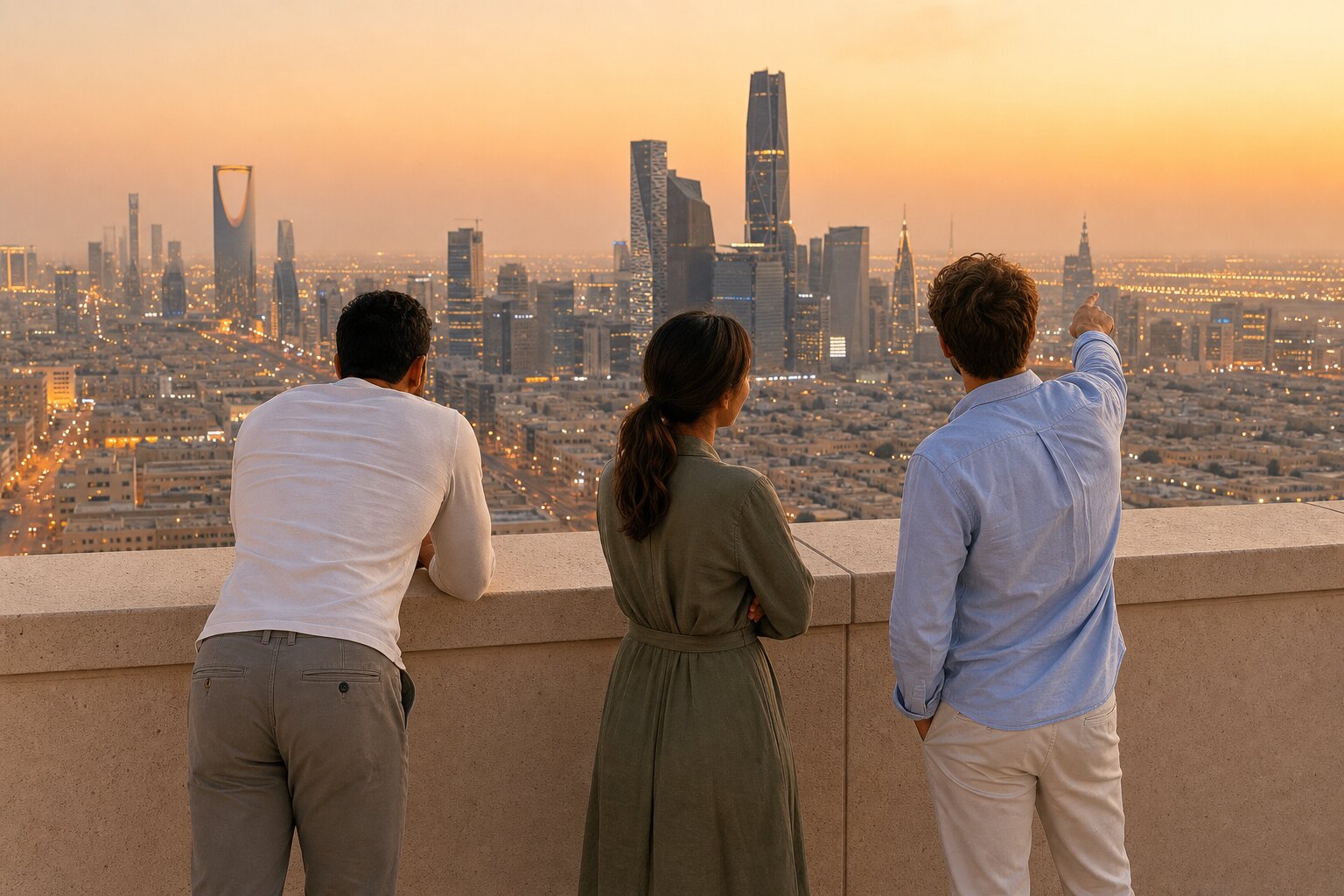
The Kingdom Centre Sky Bridge is the classic Riyadh view: three hundred metres up and the city spreading out until it disappears. It works best just before sunset, so you get both versions of the city in one trip up.
L1
stc — Crosses with line 2, in the middle of Olaya. About ten minutes on foot.
5
The architecture of KAFD
The King Abdullah financial district is an entire urban experiment: towers by international practices, elevated walkways and a Zaha Hadid metro station that is on its own a reason to go. It impresses even if architecture is not your thing.
L4
KAFD — The biggest interchange on the network: lines 1, 4 and 6 in the same building.
6
King Salman Park late in the day
One of the projects with which Riyadh is trying to stop being only asphalt. The open section already works as the place the city comes out to walk when the heat eases, which in spring is from six onwards.
L5
King Salman Park — Line 5 runs almost entirely in tunnel under King Abdulaziz Road.
7
The Edge of the World
A 300-metre escarpment an hour and a half from the city, with the desert opening out to the horizon. It is the excursion everyone remembers from Riyadh. You need a 4x4 and a guide: it is not a track for a hire car.
sin metro
Booked as a trip from the city. There and back, a long half day.

And the adventure we run here

Everything above you can do on your own with this page open. This other thing we build for you: the same idea as always — you do not know what you got until the day before — applied to Riyadh.

GO RED
Desert at dawn, with no idea where you end up
The Go Red version of Riyadh leaves the city before sunrise. We pick you up at a metro station and from there we open the plan: it could be an escarpment with a hundred-kilometre view, it could be red dunes, it could be a canyon you can only do on foot. You find out the day before.
  • The activity, booked and set up
  • 4x4 transfer with a guide
  • Kit and insurance
  • A meeting point with a metro stop
Flights and accommodation are not included — you book those. When you pick your departure city we send you a rough estimate of what they cost. We are not a travel agency. How the process works, step by step.

You choose where you fly from and where you are going, and we tell you what the adventure costs and roughly what getting there would cost. Flights and accommodation you book yourself: we are not a travel agency and we do not want to be.

How the transport works, in four numbers

Riyadh fares go not by distance but by time: you buy two hours, three days or a month, and within that period you travel without limit on metro and bus, transfers included.

2-hour ticket
4 SAR
Standard class, unlimited metro and bus journeys for two hours from first validation. First class, in a separate carriage, is 10 SAR.
3-day pass
20 SAR
The option that makes sense for a short trip. The 7-day is 40 SAR and the 30-day 140 SAR.
Hours
Sat–Thu 05:30–00:00 · Fri 10:00–00:00
On Fridays service starts at ten in the morning, after jumu'ah prayers.
Frequency
3–10 min
Every 3 to 5 minutes at peak and 5 to 10 the rest of the day, the same across the network.
Source: Riyadh Public Transport (RPT), via our Riyadh metro guide. Checked on 01 September 2026.

With two or three long trips a day, the three-day pass pays for itself on the first. It is bought and validated in the darb app, which is worth installing before you arrive.

If you want it line by line — which stations each one has, what is around every stop and how to work out a specific journey — we have all of it at our guide to the Riyadh metro. It is one of the sites we publish ourselves, and it is free.

From the airport to the centre

King Khalid airport has had its own metro since December 2024, and that has changed arriving in the city completely.

Line 4 (yellow)
4 SAR
~45 min to KAFD
Three stations at the airport — T1-2, T3-4 and T5 — ending at KAFD, where you change to line 1 for the centre or historic Riyadh.
Taxi or ride-hailing
variable
35–50 min
Still the fastest door to door, and at unsocial hours the only option, because the metro closes at midnight.
If you arrive in daylight and are not loaded down, line 4 and a change at KAFD put you in the centre for four riyals. If you land in the small hours, do not even consider it: taxi.
Source: Riyadh Public Transport (RPT). Checked on 01 September 2026.

Four things you will be glad you knew

The heat sets the plan, not the other way round
From June to September it passes 45 °C easily and the city reorganises itself around the night. The best time to go is November to March, and even then outdoor things are left for dusk.
The tourist visa is done online
Saudi Arabia opened to tourism in 2019 and the eVisa is now processed online for most European nationalities. No invitation or organised tour needed.
The dress code has relaxed, but it exists
Foreign women no longer need an abaya, but do need clothing covering shoulders and knees. For men, long trousers. In religious areas, dress more conservatively.
Fridays change the rhythm of everything
The metro does not open until ten, many shops close at midday and the city moves in the afternoon. It is the worst day to plan early visits.

Frequently asked questions

Three full days cover Diriyah, the National Museum, the historic centre and a desert trip. With two you see the city but you miss what is outside it, which is precisely the best part.

Now yes, which was unthinkable two years ago. With the six metro lines and a ride-hail for the last kilometre you can do everything. What still needs a car or a tour is leaving the city.

The two-hour ticket is 4 SAR in standard class and 10 SAR in first, with unlimited metro and bus travel in that time. Passes are 20 SAR (3 days), 40 SAR (7 days) and 140 SAR (30 days).

Yes, line 4 (yellow), with three stations at the terminals. It ends at KAFD, where you connect with line 1 into the centre. It closes at midnight, so night flights need a taxi.

Common crime is very low and is not a practical concern. What is worth doing is reading up on local rules of conduct before you go: they differ from European ones and they are enforced.

And if you fancy being surprised?

This is what we do when we travel. The other thing we do is build adventures where you do not know which activity you got until the day before.

Danos tus datos y te llamaremos.