
Riyadh went from being impossible without a car to having six metro lines in barely a month of openings. It is the most abrupt mobility change we have seen in any capital, and it is still in almost no guidebook.
The first three lines opened on 1 December 2024, two more on the 15th of the same month and the last on 5 January 2025. In other words: the whole network came into service in five weeks. Nothing written about getting around Riyadh before 2025 is any use.
Line 1 (blue) is the spine: it runs Olaya and King Abdulaziz Road north to south and links the KAFD financial district, the Olaya towers and historic Riyadh — National Museum, Al Bat’ha, Qasr Al Hokm. That line alone covers most of a visit.
Line 4 (yellow) is the airport line and line 5 (green) the ministries one. Lines 2, 3 and 6 cross the city side to side and mainly serve people who live here.
What you have to grasp about Riyadh is the scale: it is an enormous flat city built for the car, with distances you do not walk. The metro does not turn it into Amsterdam, but it does turn the three or four long trips of the day into something trivial. For the last kilometre, a taxi or an app.
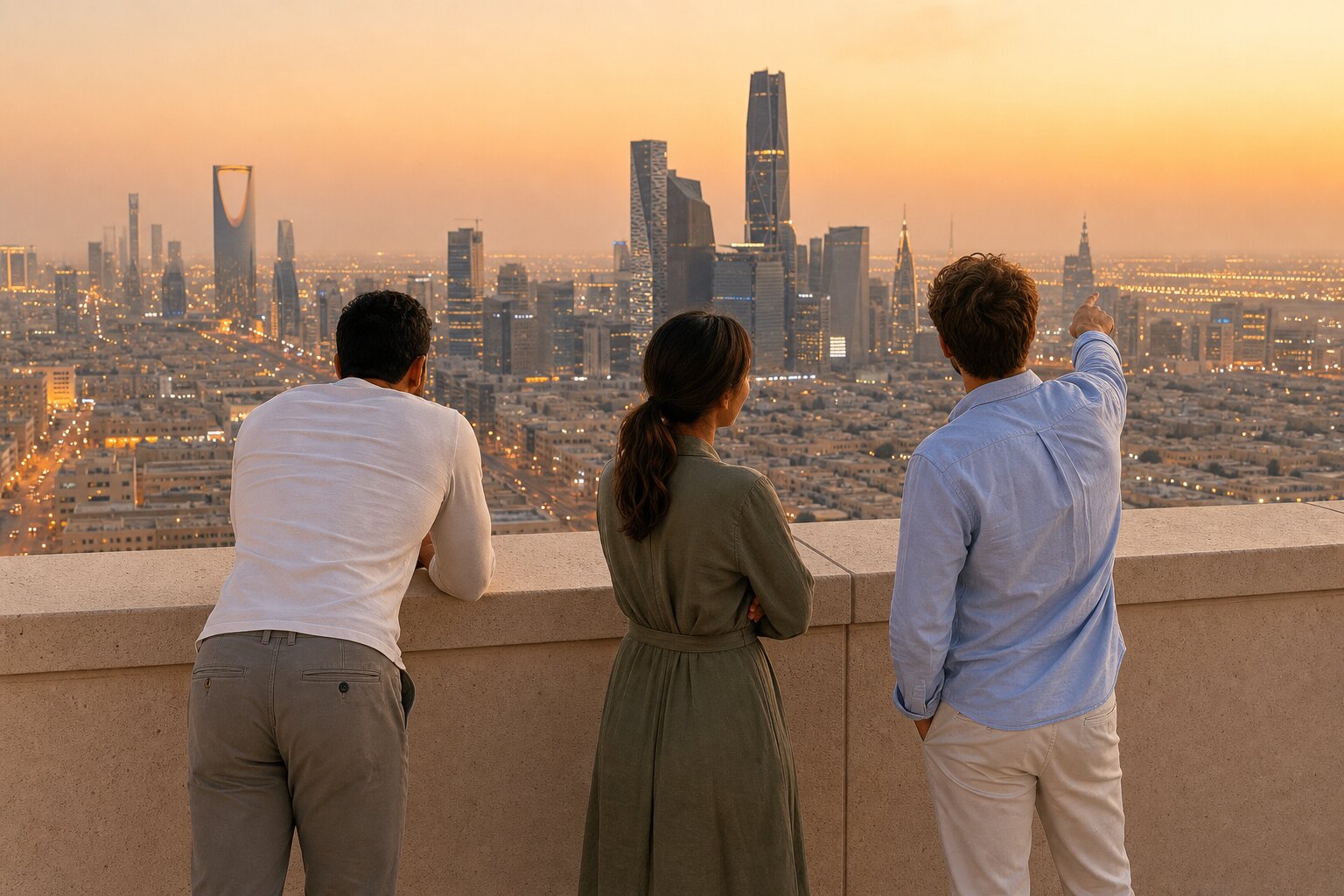
Riyadh is not a city for wandering: it is a city of specific destinations. These are the ones we think earn the trip.
Everything above you can do on your own with this page open. This other thing we build for you: the same idea as always — you do not know what you got until the day before — applied to Riyadh.
You choose where you fly from and where you are going, and we tell you what the adventure costs and roughly what getting there would cost. Flights and accommodation you book yourself: we are not a travel agency and we do not want to be.
Riyadh fares go not by distance but by time: you buy two hours, three days or a month, and within that period you travel without limit on metro and bus, transfers included.
With two or three long trips a day, the three-day pass pays for itself on the first. It is bought and validated in the darb app, which is worth installing before you arrive.
If you want it line by line — which stations each one has, what is around every stop and how to work out a specific journey — we have all of it at our guide to the Riyadh metro. It is one of the sites we publish ourselves, and it is free.
King Khalid airport has had its own metro since December 2024, and that has changed arriving in the city completely.
Three full days cover Diriyah, the National Museum, the historic centre and a desert trip. With two you see the city but you miss what is outside it, which is precisely the best part.
Now yes, which was unthinkable two years ago. With the six metro lines and a ride-hail for the last kilometre you can do everything. What still needs a car or a tour is leaving the city.
The two-hour ticket is 4 SAR in standard class and 10 SAR in first, with unlimited metro and bus travel in that time. Passes are 20 SAR (3 days), 40 SAR (7 days) and 140 SAR (30 days).
Yes, line 4 (yellow), with three stations at the terminals. It ends at KAFD, where you connect with line 1 into the centre. It closes at midnight, so night flights need a taxi.
Common crime is very low and is not a practical concern. What is worth doing is reading up on local rules of conduct before you go: they differ from European ones and they are enforced.
This is what we do when we travel. The other thing we do is build adventures where you do not know which activity you got until the day before.