Climbing
One of the 17 activities you could get with Go Orange, from €35 per person. Like all of them, you do not find out this is the one until between 48 and 24 hours beforehand.
About climbing
What is climbing?
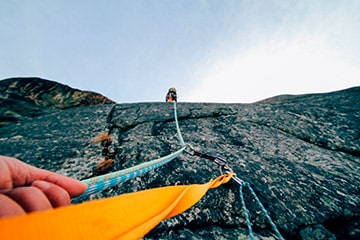
The climbing is the mountain activity for showing what your strength and balance can do. It takes real skill to get up steep rock faces. It works for adventurers of any age. Face the drop and take it on.
You can climb on your own or in a group. Bring comfortable footwear suitable for climbing, and do not worry if it is your first time: there are grades for beginners and for experienced climbers alike.
Activity at a glance
What you need to go climbing
- The professional guide carries accident and public liability insurance.
- They provide the following:
- Climbing shoes.
- A harness.
- A locking carabiner and belay device
- Helmet.
- Water during the session.
Duration
This activity lasts about 3 hours, depending on how it goes and on the weather.
How much climbing costs
This activity costs €32 per person and includes the experience, the kit and video of the session.
Where to go climbing
You can go climbing in Bizkaia
It is also possible to climb in Gipuzkoa
And you can also climb in Álava
Types of climbing
Climbing divides into grades of difficulty and into different styles. Here are the ones that exist today:
- On-sight. The climber goes up with no prior information about the route at all. No specific preparation, which makes it harder — and makes it a particular kind of experience, all discovery.
- Flash. The opposite: the climber has been told about the route beforehand and may even be given information from below during the ascent — where they are, the key moves, the holds. That makes it a good deal easier than on-sight, but it only counts if they get up first go.
- Redpoint. The most common style among climbers: you work a route, trying it over and over until you link it clean. It is also the style in which the hardest grades are climbed.
- Bouldering. Also very popular, because the difficulty is lower and it suits beginners. It is climbing done on boulders or indoor walls of no great height, so a fall is not dangerous. The other difference is that no ropes are used: what matters is doing the moves properly. Because it needs so little kit, it is what most people train on when there is no time to travel to a big wall.
- Sport climbing. As the name suggests, this is the competition circuit. The walls are usually resin with artificial holds, and the aim is to get as high as possible within a time limit. The style is completely different from climbing on rock, though the physical effort is the same. It was on show at the Tokyo 2020 Olympics , where the Spanish climber Alberto Ginés López took gold. The events were held at the Aomi Urban Sports Park in Tokyo from 3 to 6 August 2021.
Types of climbing
The sport consists of getting up a vertical face, whether that is a mountain, a crag, a slope or an indoor wall. Moving on it properly asks for stamina, strength and flexibility.
It also asks for technique, without which the fitness is wasted. Learning it is what lets you progress, and it is also what saves your strength: a great many moves cost far less when they are done well.
So the two together are what count — and they are not the only thing. To climb safely you have to climb somewhere safe.
Plenty of crags have marked, bolted routes where you can climb without worrying.
Most people climbing concentrate on the upper body and give the lower half very little thought. Attention goes to the arms and hands and what they can do, because that feels safer and because we trust them more.
It is the wrong instinct. Trusting the arms too much means over-using them, and every move then costs more than it should. Which is exactly why footwork matters so much.
Good foot placement makes you steadier and the climbing smoother. Used well, feet make every move cheaper and can even save you moves altogether. You feel the difference immediately.
People neglect their feet because they do not trust them, so here are a few pointers to using them properly — and to building that trust.
Foot placement in climbing
There are three ways of using the foot, each relying on a different part of it:
You use the sole on smearing moves. Those sections have no relief to speak of, so the other parts of the foot are no use.
Look for the flattest part of the wall, put the sole on it and move your weight over that point. Keep control of the pressure: lose it and the foot slips.
Then the edges, inside and outside. Edging uses the sides of the foot, and which one you use depends on where your hip is.
If the hip is externally rotated — knee pointing outwards — you use the inside edge. That is the one for moving while you are close in to the wall.
As for the outside edge, that is for when the hip is internally rotated. Use it on small edges, where it lets you place the foot more precisely.
And finally the toe, which is what you use on small pockets: you put the toe in and stand on it. Using it well means controlling how much force you put through it.
Having covered what climbing is, how to do it well and why fitness, technique and safety all matter, here are the types you can practise, according to where they happen and what they need.
Starting with traditional climbing , the one most amateur climbers do. It means climbing routes with protection placed carefully along the way, so that the climber is secure throughout.
It uses removable gear that you get back afterwards: cams, pitons and nuts.
Next there is speed climbing. It is the most spectacular to watch and the one with the most competitions: get up in the shortest time possible. Agility and technique are what decide it, and it happens in controlled settings — an indoor wall or a set vertical face.
Another one, which asks a great deal of you, is free soloing. Here the climber has nothing but their own body. Which is why it should be left to professionals and experts: the risk is considerable.
For grip, climbers use specialist shoes and chalk. As we said, nothing else.
Then there is aid climbing, where the climber may use equipment to make progress: ladders, hooks and whatever else is needed. Which means studying the wall carefully beforehand, so that everything required for the ascent is prepared and carried.
That leaves bouldering and alpine climbing.
The Bouldering is one of the styles everyone is doing, because it needs no great travel and is straightforward to organise.
The problems are short and no protection is used, because a mat goes down underneath in case of a fall. The only kit is climbing shoes and chalk.
The Alpine climbing is, along with free soloing, the style that carries the most risk. It asks for a great deal of experience, for specific skills and for the right equipment for the particular ascent.
Some of these take several days, which brings in a whole other set of skills: navigation, cooking with what you carry, first aid, knowing the ground as well as you can and reading a map.
Climbing season
This kind of activity runs from March to October, because it depends on the weather to be run properly.
A bit more about climbing
For all that climbing has a reputation as dangerous, it is in fact one of the safer things you can do — provided the safety measures are respected.
On the highest summits, though, it is another matter. Did you know there is still a mountain that has not been climbed? With a qualification: K2 has not been climbed in winter. It has been attempted several times and never done. Its summit has never had anyone on it at that time of year.
K2, in Pakistan, is 8,611 metres high — the second highest mountain in the world — and one of the most dangerous.
Where competition climbing came from
The origin of competition climbing is worth a paragraph of its own
The first climbing competitionsgrew out of the meets and demonstrations that hard climbers held to measure themselves against each other and raise the bar. As in so many sports, what started as get-togethers turned into genuine contests between professionals.
The meets grew more frequent until they settled into fixed dates, with a season of training behind them.
The first competitions were held on real rock. Before long, though, the FEDME, the climbing community, the organisers and the International Federation itself realised that competing on real crags was unsustainable, given the environmental and social impact, and the answer was to move onto artificial resin walls.
Since then competitions have been held on a closed circuit, normally indoor walls rather than crags. Competitors have to get as high as possible within a time limit, following a route set for the round.
The Climbing competitions run, as in other sports, through rounds: last sixteen, quarter-finals, semi-finals and the final — or a super-final if the final ends level, which is unusual but does happen.
They are held in three categories: lead, boulder and speed. It falls to FEDME to set the national competition calendar in Spain each year, where the best sport climbers in the country compete.
The current annual calendar includes a Spanish Lead Cup, across three rounds, and the Spanish Boulder and Lead Championships. Alongside the usual national competitions such as the Spanish Championship and a Junior Spanish Lead Cup, also known as development climbing , which keeps young climbers coming into the sport year after year.
Related activities in the Basque Country