There is a wide range of Basque rural sports, and most of them reflect the culture and identity of the Basque Country exactly. If you are planning to visit, it is worth knowing what they are.
What makes them particular is that they are built on the work done here, or on work that used to be common.
Which is why some people see them as a very fine way of honouring the region’s roots. They can also be extremely demanding physically, or simply look heavy going.
The reason is that most of them come from the countryside — several of them let you work as a woodcutter would.
The sports themselves
In Basque they are called “herri kirolak”, which means the sports of the people. They are not especially technical, nor heavy with rules — there is room for spontaneity.
As a rule, the Basque rural sports test your endurance, your coordination and your strength, and they are a very good way of finding out what you are made of. The Bizkaia herri kirolak federation publishes a calendar of the main competitions.
Here are some of them, held at different times of year:
Eskupilota, or Basque pelota
The most popular of the lot. In Basque it is eskupilota.
It consists of striking a ball with considerable precision. It looks simple; it is not.
Basque pelota is played by two players, or by two pairs . Players take turns to strike the ball against the front wall, the frontis.
It can be played on a small covered court or on a larger one called a frontón. There is now an international federation.
That federation recognises at least four formats. One of the most common is trinquete, played with a paddle and a rubber ball.
Sokatira
One of the most exciting and also one of the most accessible. Teams are formed of at least eight people.
Each team holds a heavy rope and pulls, with the aim of dragging the other team into its own half. Whoever manages it wins.
One criterion matters in competition: the teams’ weights have to be balanced, since a clear difference decides the result on its own.
And because it is traditional and needs almost no equipment, it turns up regularly in PE lessons. Children love it.
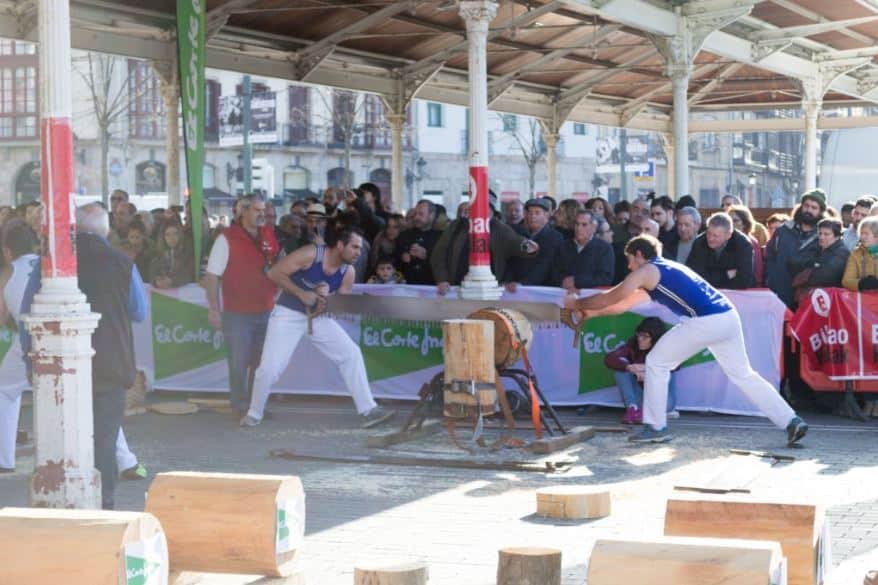
Aizkolari
A very traditional sport that demands considerable strength: you cut logs with an axe.
In Basque it is also aizkora jokoa, the game of axes. To compete you need an axe weighing between 2.5 and 2.8 kg, with a curved blade.
That shape makes it far easier for the blade to enter and leave the wood. The logs are usually green beech, up to 72 inches.
There is even an event called the Golden Axe. In 2006 it drew significant entries and coverage, with as many as nine teams.
Harrijasotzaile
Another that demands raw strength: two competitors go head to head.
Each of them has to lift stones of different sizes and shapes. The winner is usually whoever manages the most lifts, and the cleanest.
Basque rural sports
Those are some of the best known. The question now: did you know them all? Have you tried them? And, more to the point, do you want to?.
It is an enjoyable way of getting close to Basque culture and to traditions that are still competitive sport today, alongside group sessions where you can try the rural sports themselves. There is more in the Go Orange range at outdoor activities on GoRandom.