
ESEN

What to do in Dhaka and how to get around by metro

Dhaka had a reputation as the city with the worst traffic in the world. In 2022 its first metro line opened and a journey that took two hours now takes thirty-five minutes. It is the most abrupt urban change we have seen in any city we write about.

We were in Dhaka in October 2023Updated in 2026

One line running the length of the city

For now there is a single line, the MRT-6, elevated, between Uttara North — up by the airport — and Motijheel, the financial district. It is the first metro line in Bangladesh and it runs on viaduct the whole way.

That one line nonetheless covers almost everything a visitor wants: Agargaon and the ministries, Bijoy Sarani and Louis Kahn’s Parliament, Farmgate, Kawran Bazar, Shahbagh with the National Museum, Dhaka University and Motijheel.

What remains outside is the old city: Lalbagh, Ahsan Manzil and Sadarghat. There is no metro there and probably will not be for years, because the street layout does not allow it. You get there by rickshaw from Motijheel.

The fare goes by distance — five taka per kilometre, rounded into bands — and the stations are air-conditioned, which in Dhaka is not a minor detail.
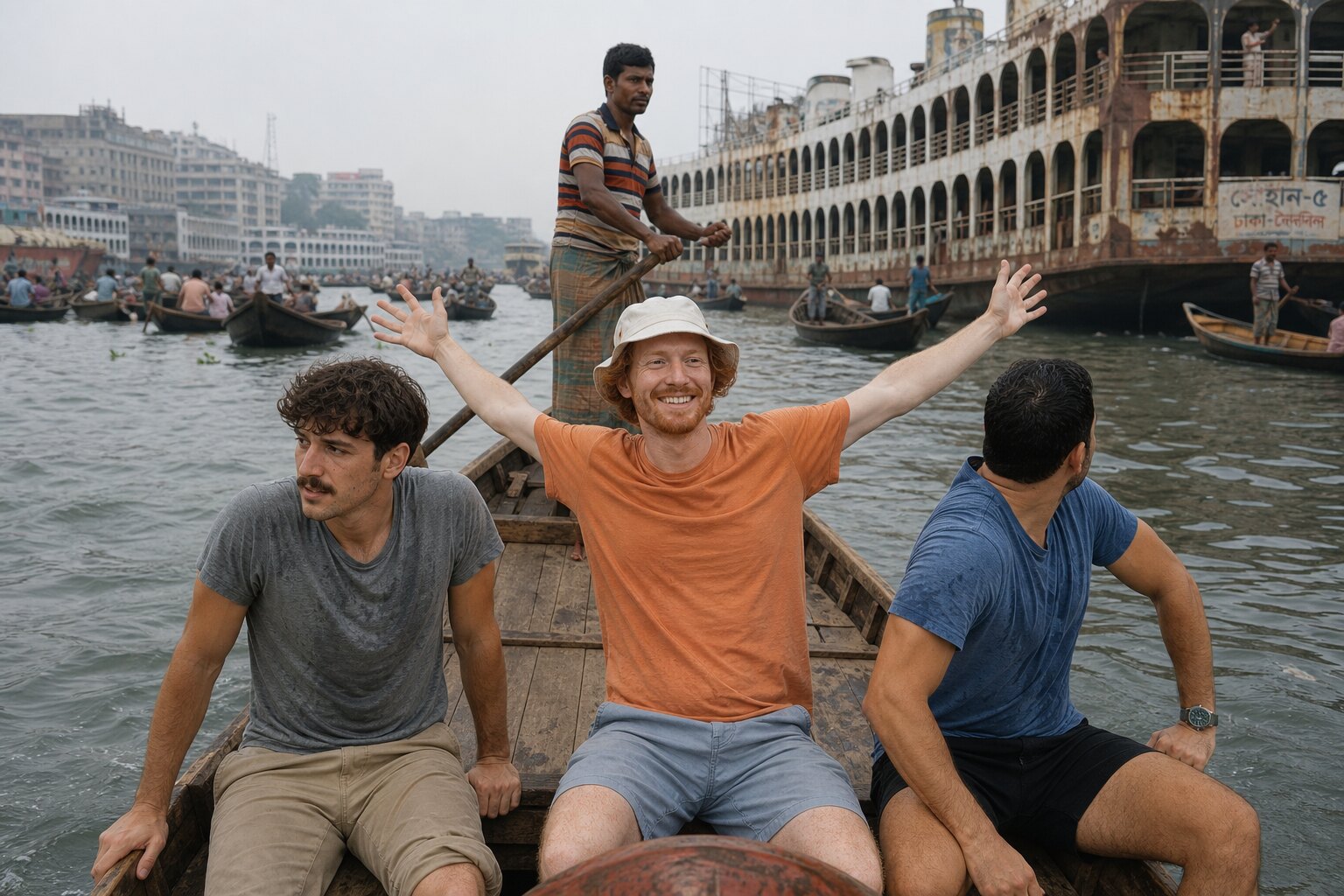
Part of the team of GoRandom in Dhaka, in October 2023
Part of the team in Dhaka, October 2023.

Seven things to do, and how to reach each one

Dhaka is not a city of isolated monuments: it is a city of intensity. These seven explain it better than a list of buildings.

1
Louis Kahn's Parliament
The Jatiya Sangsad Bhaban is one of the masterpieces of twentieth-century architecture: concrete, marble and enormous geometry surrounded by water. It reads very well from outside and at dusk, with the reflection, it is extraordinary. Interior visits need permission.
MRT-6
Bijoy Sarani — Ten minutes on foot from the station to the lake around it.
2
The National Museum and Shahbagh
Four floors telling Bangladesh from prehistory to the 1971 liberation war, which is the key to understanding the country. Around it, Shahbagh is the hub of the city's intellectual life, with the flower market running all night.
MRT-6
Shahbagh — The station comes out onto the square itself.
3
The Dhaka University campus
An enormous tree-filled campus in the centre, with the red-brick Curzon Hall, bookshops, tea stalls and the language martyrs monument. It is the quietest and most surprising place in the city.
MRT-6
Dhaka University — The station is inside the campus.
4
The old city: Lalbagh and Ahsan Manzil
The seventeenth-century Mughal fort at Lalbagh and the Pink Palace on the bank of the Buriganga are the two landmarks of old Dhaka. In between, a labyrinth of alleys, workshops and markets which is what you actually come to see.
sin metro
Metro to Motijheel and a rickshaw from there. The old city has no station and is unlikely to get one.
5
Sadarghat, the river port
One of the busiest passenger ports in the world: hundreds of three-deck boats, stevedores, and a chaos unlike anything else. You can cross the river in a rowing boat for a few taka. It is the image of Dhaka that stays with you.
sin metro
Rickshaw from Motijheel, about 20–30 minutes depending on traffic.
6
Kawran Bazar before dawn
The biggest wholesale market in the city, running at full tilt between three and six in the morning. It is hard, it is loud and it is the most honest thing you can see about how a city of twenty million feeds itself.
MRT-6
Kawran Bazar — Careful: at that hour the metro is not running yet. You will need a rickshaw.
7
Ramna Park at dawn
The big central park, with a lake, and first thing full of people doing yoga, running or simply sitting. It is the only place in Dhaka where you hear silence, and it lasts until eight.
MRT-6
Shahbagh — Five minutes on foot from the station.

And the adventure we run here

Everything above you can do on your own with this page open. This other thing we build for you: the same idea as always — you do not know what you got until the day before — applied to Dhaka.

GO RED
Into the delta, with no idea where you end up
The Go Red version of Dhaka heads into the largest river delta on the planet. We pick you up at a metro station and from there we open the plan: it could be a boat crossing through the arms of the Buriganga, it could be cycling the riverside villages, it could be a day rowing between sand islands. You find out the day before.
  • The activity, booked and set up
  • A local guide
  • Kit and insurance
  • A meeting point with a metro stop
Flights and accommodation are not included — you book those. When you pick your departure city we send you a rough estimate of what they cost. We are not a travel agency. How the process works, step by step.

You choose where you fly from and where you are going, and we tell you what the adventure costs and roughly what getting there would cost. Flights and accommodation you book yourself: we are not a travel agency and we do not want to be.

How the transport works, in four numbers

The MRT-6 charges by distance, at five taka a kilometre rounded into bands. It is cheap and, above all, predictable: something that was not possible in Dhaka before.

Minimum fare
৳20
For one or two stations. It rises in bands to the maximum.
Maximum fare
৳100
The full run, Uttara North to Motijheel. About thirty-five minutes for a journey that on the surface can take two hours.
MRT Pass
10% discount
The rechargeable card, valid for ten years, takes a discount off every ride. Worth it from two or three days upwards.
Hours
first train 06:30 · last 22:30
Saturday to Thursday. The first train leaves Uttara North at 06:30 and Motijheel at 07:15.
Source: DMTCL, via our Dhaka metro guide. Checked on 01 September 2026.

What most orders a trip here is planning the long journeys along the line and leaving rickshaws for the last kilometre. It is exactly the opposite of what everyone did three years ago.

If you want it line by line — which stations each one has, what is around every stop and how to work out a specific journey — we have all of it at our guide to the Dhaka metro. It is one of the sites we publish ourselves, and it is free.

From the airport to the centre

Hazrat Shahjalal international airport is to the north, near the end of the metro line but without a station at the terminal itself.

Taxi or ride-hail to Uttara + metro
variable + MRT fare
50–70 min
A short car ride to a northern station and the MRT-6 into the centre from there, skipping the worst of the traffic.
Direct taxi
variable
45 min – 2 h
The range is not a mistake: it depends entirely on the hour. Mid-afternoon it can be very long.
If you arrive at rush hour, combining a short car ride with the metro is faster and far more predictable than a direct taxi. Outside those hours, the direct taxi wins.
Source: DMTCL. Checked on 01 September 2026.

Four things you will be glad you knew

The rickshaw still rules the last kilometre
Dhaka has hundreds of thousands of them and they are the only reasonable way through the narrow streets. Agree the price before getting in, always.
The best season is November to February
That is the dry winter: bearable heat and little rain. June to September is the monsoon, with flooding common in the city itself.
Friday is the day of rest
The weekend in Bangladesh is Friday and Saturday. On Friday morning the city is unusually calm, which is the best moment for the old city.
The metro has a women-only carriage
There is a reserved car, marked on the platform. It is respected and it is worth checking before boarding.

Frequently asked questions

Two or three. One for the metro axis — Parliament, Shahbagh, the university — one for the old city and Sadarghat, and a third if you want to get out to the river or to Sonargaon.

Between 20 and 100 taka depending on distance, at five taka a kilometre rounded into bands. The full run, Uttara North to Motijheel, costs ৳100.

Not directly: the MRT-6 passes close to the airport but has no station at the terminal. The practical route is a short car ride to a northern station and the metro from there.

Violent crime against foreigners is uncommon, but it is an intense and very crowded city. The sensible things: look after valuables, agree the rickshaw fare before getting in and avoid political gatherings.

November to February, the dry winter. The monsoon, June to September, brings flooding to the city itself, and April and May are the hottest months.

And if you fancy being surprised?

This is what we do when we travel. The other thing we do is build adventures where you do not know which activity you got until the day before.

Danos tus datos y te llamaremos.