
ESEN

What to do in Miami and how to get around without a car

Miami has an elevated train, a flat $2.25 fare and a downtown you can cover on a free monorail. And almost everyone still rents a car. It can be done differently: you just need to know how far the train goes and where it stops being useful.

We were in Miami in March 2023Updated in 2026

One track, two services and a free monorail

The Metrorail is a single elevated track of 23 stations with two services on it: the Green Line, running the whole thing from Palmetto to Dadeland South, and the Orange Line, which branches at Earlington Heights towards the airport.

Between Earlington Heights and Dadeland South the two share track, so on that stretch — the useful one — a train comes every eight minutes on weekdays. Flat fare: $2.25 wherever you go.

Downtown there is also the Metromover: an automated, elevated and free monorail running three loops through Downtown, Brickell and Omni. It is the best way to move around the centre and plenty of people do not know it exists.

And then there is what the train does not cover, which is a fair amount: South Beach, Wynwood and the Everglades have no station. For South Beach there is a bus from Downtown; for the rest, bus or ride-hailing. That is the real limit of doing Miami without a car.
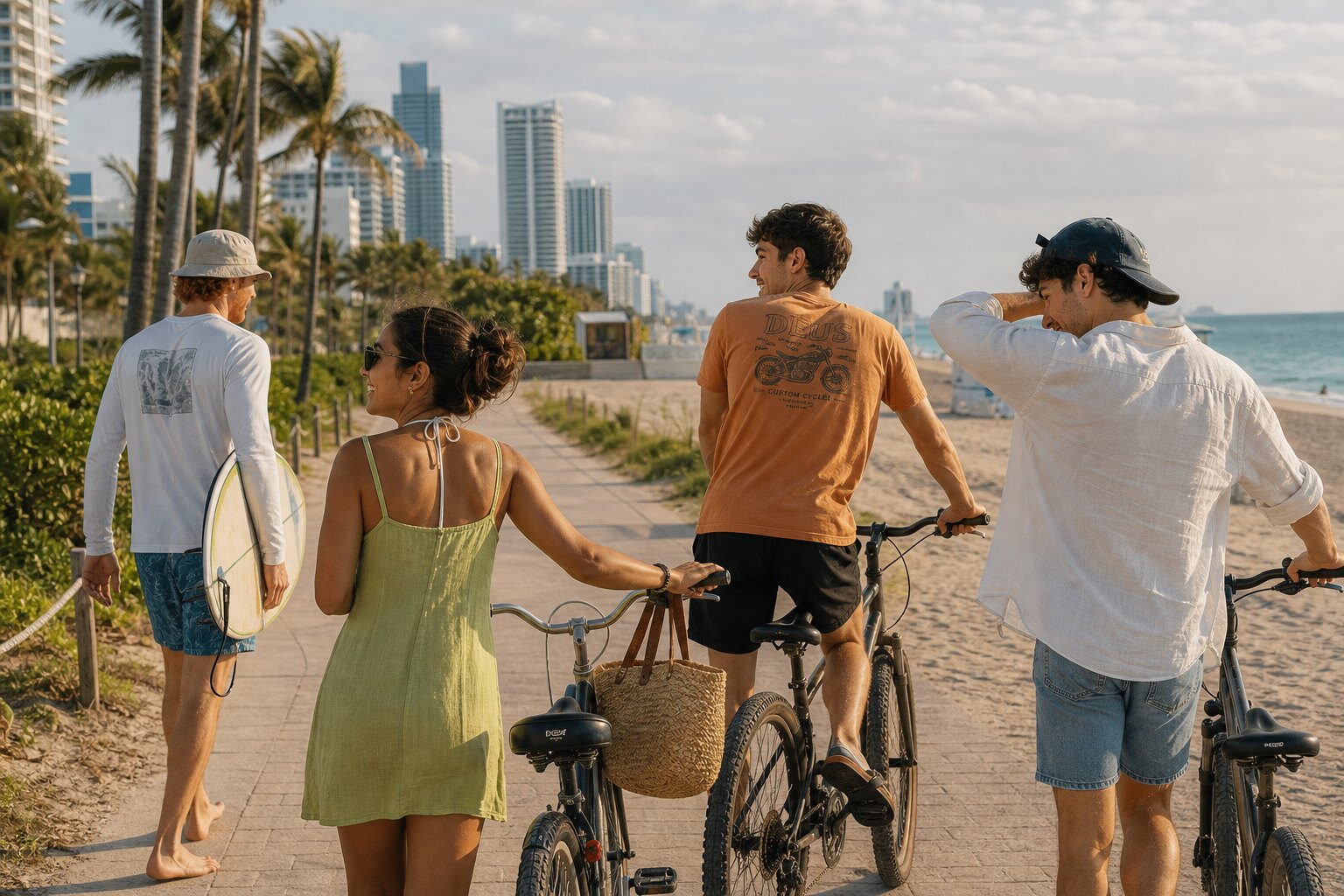
Part of the team of GoRandom in Miami, in March 2023
Part of the team in Miami, March 2023.

Seven things to do, and how to reach each one

South Beach included, obviously, with the warning that it is the part of Miami that sits worst with public transport.

1
Vizcaya, the Italian palace on the bay
A Venetian-style villa from 1916 with ten formal gardens, grottoes and a stone barge in the water. It is the most beautiful thing in Miami and it is at a train stop, which almost nobody takes advantage of. Tickets are booked by time slot.
Green
Vizcaya — The station has the same name and is five minutes from the entrance.
2
Coconut Grove, the oldest neighbourhood
Bay, enormous trees, a marina and shaded streets: this is the Miami that predates the towers and it is still the most pleasant district for an afternoon on foot. Next to it is Peacock Park, with peacocks loose in it.
Green
Coconut Grove — Fifteen minutes on foot to the middle of the neighbourhood.
3
Downtown on the Metromover, free
Three elevated loops over the centre, driverless and free. It is an aerial tour of Downtown and Brickell for zero dollars, and it gets you to Bayside, the Frost Museum of Science and the Pérez Art Museum.
Green
Government Center — The Metrorail station connects directly to the Metromover.
4
Little Havana and Calle Ocho
Cuban coffee windows, dominoes in Máximo Gómez Park and cigar workshops. It is the district with the strongest identity in the city and it is walked between 12th and 17th streets.
Orange
Brickell — From there bus 8 runs the length of Calle Ocho. Ten minutes.
5
Coral Gables and the Venetian Pool
A planned city from the 1920s, with tree-lined streets, the Miracle Mile and a public pool dug out of a coral quarry and fed by a spring. It is the strangest and prettiest place to swim in Miami.
Green
Douglas Road — From there a bus, or twenty minutes on foot to the Miracle Mile.
6
South Beach and the Art Deco District
Ocean Drive, the pastel art deco facades and the white sand. It works far better early in the morning, when the district is an open-air museum rather than a terrace with a sound system.
sin metro
There is no station on Miami Beach. It is bus 120 from Downtown, about 30–40 minutes.
7
The Everglades, in a day
A river of grass the width of a county, with alligators, herons and boardwalk trails. The Anhinga Trail takes an hour and you will almost certainly see alligators. The airboat thing is loud and skippable.
sin metro
Here you do need a car or an organised trip. Full day.

And the adventure we run here

Everything above you can do on your own with this page open. This other thing we build for you: the same idea as always — you do not know what you got until the day before — applied to Miami.

GO ORANGE
On the water, with no idea what you got
The Go Orange version of Miami goes into the bay. We give you a meeting point with a train station and from there we open the plan: it could be kayaking through the Biscayne mangroves, it could be kitesurfing on the afternoon wind, it could be a paddleboard crossing to the channel islands. You find out the day before.
  • The activity, booked and set up
  • Kit and insurance
  • A local instructor
  • A meeting point with a Metrorail station
Flights and accommodation are not included — you book those. When you pick your departure city we send you a rough estimate of what they cost. We are not a travel agency. How the process works, step by step.

You choose where you fly from and where you are going, and we tell you what the adventure costs and roughly what getting there would cost. Flights and accommodation you book yourself: we are not a travel agency and we do not want to be.

How the transport works, in four numbers

Miami-Dade Transit runs it. Flat fare: distance makes no difference and neither does the line.

Single ride
$2.25
Any distance and either line. The transfer to a bus is free.
Reduced fare
$1.10
Medicare beneficiaries, most people with disabilities and school students, with a reduced-fare EASY Card.
Metromover
free
The downtown monorail costs nothing, not even a ticket. It covers Downtown, Brickell and Omni.
Hours
from ~05:00 on weekdays
First trains around 5:00 on the Green Line and 5:04 on the Orange. At weekends the Orange runs only as an airport shuttle.
Source: Miami-Dade Transit, via our Miami Metrorail guide. Checked on 01 September 2026.

The detail that catches people out: at weekends the Orange Line does not run the full route. If your Saturday plan depends on it, check before leaving the hotel.

If you want it line by line — which stations each one has, what is around every stop and how to work out a specific journey — we have all of it at our guide to the Miami Metrorail. It is one of the sites we publish ourselves, and it is free.

From the airport to the centre

Miami airport is connected by train from the Miami Intermodal Center, one of the better interchanges in the United States.

Orange Line
$2.25
20–25 min to Downtown
From the MIC station, linked to the terminals by the MIA Mover. Straight down to Government Center, dead centre.
Tri-Rail or ride-hailing
variable
depends on destination
The Tri-Rail runs north to Fort Lauderdale and West Palm Beach from the same interchange. For Miami Beach, ride-hailing or bus 150.
If you are staying in Downtown or Brickell, the Orange Line is unbeatable: two and a quarter dollars and twenty minutes. Sleeping in South Beach, count on one more connection.
Source: Miami-Dade Transit. Checked on 01 September 2026.

Four things you will be glad you knew

It works without a car, but pick the hotel carefully
Staying in Brickell, Downtown or near a Metrorail station changes the experience completely. In South Beach without a car you depend on the bus for everything else.
The tip is not optional
In restaurants you leave 18–20%, and many bills already add it as a service charge: check, so you do not pay it twice.
June to November is hurricane season
It does not mean anything will happen, but it does rain hard most afternoons. March and April are the best months: heat without extreme humidity.
Spanish works across the city
More than half of Miami-Dade speaks it. In many neighbourhoods it is the default language, transport included.

Frequently asked questions

Yes, if you choose where you sleep carefully. With the Metrorail, the free Metromover and the odd bus you cover Downtown, Brickell, Coconut Grove, Coral Gables and Vizcaya. What is not well covered is Wynwood, South Beach and any trip to the Everglades or the Keys.

$2.25 a ride, any distance and either line, with a free transfer to the bus. The reduced fare is $1.10 and the downtown Metromover is free.

Yes, the Metrorail Orange Line leaves from the Miami Intermodal Center, linked to the terminals by the MIA Mover, and reaches Downtown in about twenty minutes. At weekends that service runs only as an airport shuttle.

Three or four. Two for the city — Downtown, Little Havana, Coconut Grove, Vizcaya — one for South Beach and the art deco, and one for the Everglades or the Keys.

December to April: pleasant heat, little rain and bearable humidity. Summer is humid and stormy, and June to November is hurricane season.

And if you fancy being surprised?

This is what we do when we travel. The other thing we do is build adventures where you do not know which activity you got until the day before.

Danos tus datos y te llamaremos.