
ESEN

What to do in Oslo and how to get around

Oslo has the only metro network in the world that drops you inside a thousand-square-kilometre forest on a city ticket. That single fact explains the place better than any list of museums.

We were in Oslo in April 2025Updated in 2026

Five lines that meet in the centre and fan out beyond it

The T-bane is five lines — T1 blue, T2 orange, T3 purple, T4 green and T5 yellow — with 101 stations over 85 kilometres. In the centre they share a common tunnel, so between Majorstuen and Tøyen any train will do.

Outside that tunnel each one goes to its own branch, and there the number matters. It is the same scheme as Stockholm: shared trunk in the middle, fan on the edges.

What makes Oslo special is the T1: it climbs the hillside to Frognerseteren, 470 metres up, through the villa district, and leaves you at the door of the Nordmarka, the forest where the city skis, runs and walks. It is urban metro that ends on a footpath.

For the centre you barely need it: Oslo is compact and from the Royal Palace to the Opera House is a twenty-minute walk along the fjord.
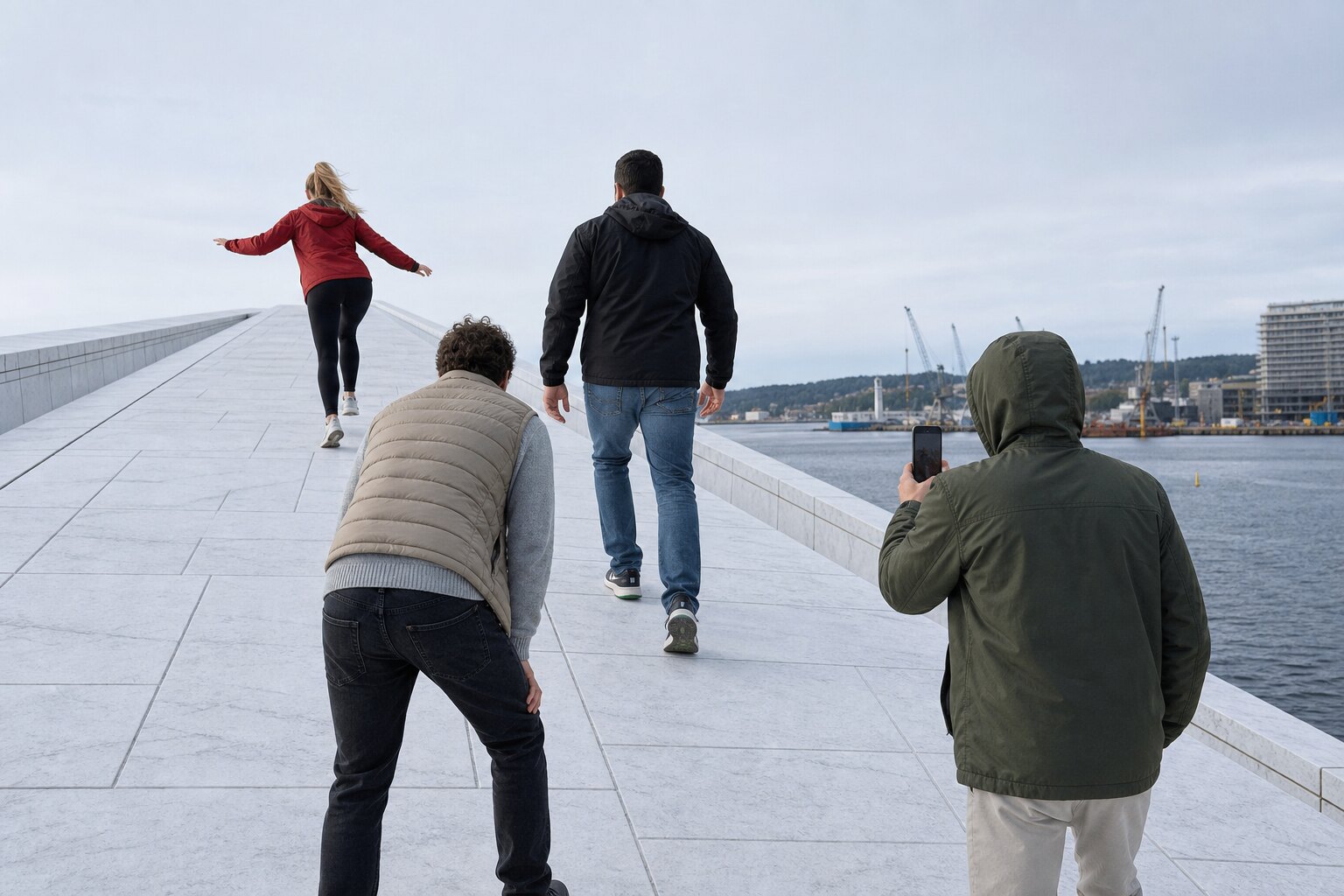
Part of the team of GoRandom in Oslo, in April 2025
Part of the team in Oslo, April 2025.

Seven things to do, and how to reach each one

Holmenkollen and the forest included, which almost nobody puts on a list and is the best thing the city has.

1
The Holmenkollen ski jump and its viewing deck
The most famous ski jump in the world, hanging over the city, with a ski museum inside the structure and a viewing platform on top. You see the whole of Oslo and the fjord opening out. The jump simulator is a silly thing that is worth doing.
T1
Holmenkollen — Half an hour from the centre and the ride is half the plan: it climbs the hillside.
2
Vigeland park, sculpture mood or not
Two hundred bronze and granite figures by Gustav Vigeland in an open, free park, with the Monolith on the axis. It is not a museum with a garden: it is a local park where people jog and picnic among the sculptures.
T5
Majorstuen — All five lines stop here. Five minutes to the main gate.
3
The Opera House, walking up the roof
The building was designed to be walked over: a white marble ramp that comes out of the ground and reaches the roof, with the fjord in front. It is free, always open, and next to it is the Barcode district, where Oslo shows you what it spent the money on.
T2
Jernbanetorget — All five stop here. You leave the central station and it is in front of you.
4
The Munch museum, unhurried
Thirteen floors beside the Opera with the bulk of Munch's work, including versions of The Scream that rotate for conservation. The top floor has one of the best indoor views of the fjord.
T1
Jernbanetorget — Ten minutes on foot along the waterfront from the central station.
5
Walking into the Nordmarka from the end of the T1
At Frognerseteren the metro ends and the forest starts: trails, lakes and a lodge with hot chocolate. In winter people get on with cross-country skis inside the carriage. It is the most Norwegian thing you can do without leaving the city.
T1
Frognerseteren — Terminus of the T1, 470 m up. Last stop and you are already in it.
6
Grünerløkka and the Akerselva river
The neighbourhood where the interesting things are now: cafés, second-hand shops, weekend markets. And right alongside, the Akerselva, a river of waterfalls and old brick factories you can walk end to end in a couple of hours.
T2
Grønland — Ten minutes north on foot. Trams 11 and 12 also get you there.
7
The Bygdøy museums in a single day
On the peninsula are the Fram — the polar ship, whole, and you go aboard — the Kon-Tiki and the maritime museum. It is the best cluster of museums in the city and it fits in a day.
sin metro
Bygdøy has no T-bane: it is the ferry from the city hall in season, or bus 30 all year.

And the adventure we run here

Everything above you can do on your own with this page open. This other thing we build for you: the same idea as always — you do not know what you got until the day before — applied to Oslo.

GO ORANGE
A day in the Nordmarka, with no idea what you got
The Go Orange version of Oslo starts where the metro ends. We give you a meeting point at a T-bane station and from there we open the plan: it could be a crossing between the Nordmarka lakes, it could be cross-country skiing if the season allows, it could be kayaking on the fjord. You find out the day before.
  • The activity, booked and set up
  • Kit and insurance
  • A local instructor
  • A meeting point with a metro stop
Flights and accommodation are not included — you book those. When you pick your departure city we send you a rough estimate of what they cost. We are not a travel agency. How the process works, step by step.

You choose where you fly from and where you are going, and we tell you what the adventure costs and roughly what getting there would cost. Flights and accommodation you book yourself: we are not a travel agency and we do not want to be.

How the transport works, in four numbers

Ruter runs it and the same ticket covers metro, tram, bus, local train and some fjord ferries. Almost everything a visitor wants is in zone 1.

Single ticket
42 NOK
Valid 60 minutes in zone 1, transfers included. Bought in the RuterBillett app; there is no ticket office on the platform.
24-hour pass
113 NOK
Pays for itself from the third journey. The 7-day is 335 NOK and the 30-day 871 NOK.
Hours
05:30 – 01:10
First trains at 05:30 and the last just after one. There is no night metro: at weekends buses cover it.
Frequency
4–7 min at rush hour
Every 7 to 15 minutes during the day and every 15 in the evening.
Source: Ruter and Sporveien, via our Oslo T-bane guide. Checked on 01 September 2026.

With two journeys a day no pass is worth it. But if you are going up to Holmenkollen and Frognerseteren on the same day, the 24-hour pass already pays for itself on that alone.

If you want it line by line — which stations each one has, what is around every stop and how to work out a specific journey — we have all of it at our guide to the Oslo T-bane. It is one of the sites we publish ourselves, and it is free.

From the airport to the centre

Gardermoen is forty-seven kilometres out and two trains do the same job at very different prices. Watch out for Torp and Rygge, sold as “Oslo” and more than a hundred kilometres away.

Flytoget
own fare, expensive
19–22 min
Express train direct to the central station, every 10 or 20 minutes. The fastest and also the dearest.
Vy regional train
cheaper
23–26 min
Leaves from the same platform, stops at the same central stations and takes barely three minutes longer. By far the best price-to-time ratio.
The recommendation here is easy: take the Vy regional train. You pay a good deal less to arrive three minutes later. The Flytoget only wins if it happens to be leaving as you reach the platform.
Source: Ruter, Vy and Flytoget. Checked on 01 September 2026.

Four things you will be glad you knew

Oslo is expensive, but not all of it
Eating out and alcohol are the two costs that catch you out. The forest, the parks, the Opera and the fjord walk are free, and the Oslo Pass only pays off if you do three museums or more in a day.
Alcohol is only sold at the Vinmonopolet
Weak beer in supermarkets until 20:00 on weekdays and 18:00 on Saturday; everything else in the state shops, which close early and do not open on Sunday.
The fjord water is there to be used
There are floating saunas and swimming spots in the middle of the city, even in winter. It is a local habit, not a tourist stunt.
In April there is still snow up top
It can be fifteen degrees downtown and there will still be snow on the trails at Frognerseteren. Go up in footwear that handles mud.

Frequently asked questions

Two full days cover the centre, the Opera, Vigeland and a museum. With three you fit all of Bygdøy plus a trip up to Holmenkollen or the forest, which is what really sets Oslo apart from other capitals.

A single zone 1 ticket is 42 NOK and lasts 60 minutes with transfers. The 24-hour pass is 113 NOK, the 7-day 335 NOK and the 30-day 871 NOK.

Only if you are going to chain three paid museums in one day, and it does include transport. If your plan is more streets, fjord and forest — which is what we recommend — a plain transport pass is cheaper.

Yes, and it is the best thing about the network. Line T1 ends at Frognerseteren, 470 metres up and right at the entrance to the Nordmarka. On a normal city ticket.

Gardermoen (OSL), the one connected by train in twenty minutes. Torp and Rygge are sometimes advertised as “Oslo” but they are over a hundred kilometres away and the transfer eats the fare saving.

And if you fancy being surprised?

This is what we do when we travel. The other thing we do is build adventures where you do not know which activity you got until the day before.

Danos tus datos y te llamaremos.