
ESEN

What to do in Warsaw and how to get around by metro

Warsaw was rebuilt from photographs and paintings after 1945. Knowing that before you set foot in the old town changes completely what you are looking at: it is not a medieval city, it is an act of will.

We were in Warsaw in June 2023Updated in 2026

Two lines in a cross and a single interchange

The Warsaw metro is two lines and 38 stations. The M1 (blue) runs north to south, Młociny to Kabaty; the M2 (red) east to west, Bemowo to Bródno. They cross at exactly one point: Świętokrzyska.

That makes the network trivially easy to use — you are on one axis or the other, and at most you change once — but it also leaves gaps. Warsaw is very large and plenty of things sit far from both lines.

That is where the tram comes in: dense, old, and it covers what the metro does not. The ticket is the same, so metro plus tram is how you actually get around.

The old town, incidentally, has no station of its own. You get to Ratusz Arsenał on the M1 or Nowy Świat-Uniwersytet on the M2 and finish on foot along the Royal Route, which is part of the plan.
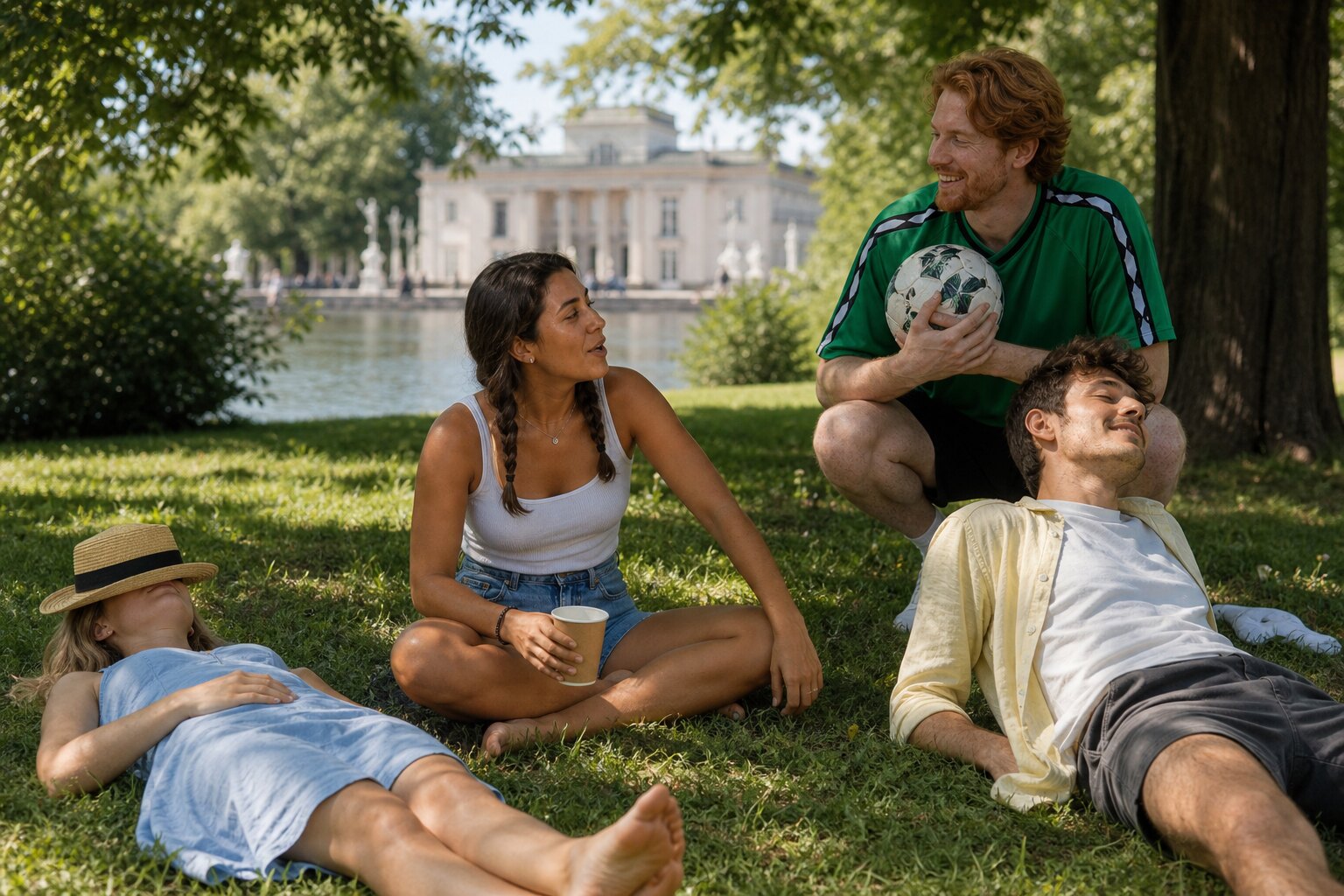
Part of the team of GoRandom in Warsaw, in June 2023
Part of the team in Warsaw, June 2023.

Seven things to do, and how to reach each one

Warsaw cannot be understood without its twentieth century, so there are more museums here than usual. Every one on the list earns its place.

1
The rebuilt old town, knowing that it is one
The Market Square, the walls, the Barbican and the Royal Castle are a post-war reconstruction so meticulous that Unesco listed it precisely for that. You walk it in a morning.
M1
Ratusz Arsenał — Ten minutes on foot to Castle Square.
2
The Warsaw Uprising Museum
63 days of 1944 told with an intensity that leaves a mark. It is one of the best-designed museums in Europe and also one of the hardest; it is not a passing visit, set aside three hours.
M2
Rondo Daszyńskiego — Ten minutes on foot from the exit.
3
POLIN, the history of Polish Jews
A thousand years of history on the ground of the ghetto, and not only the Holocaust: most of the museum is about the life before. It is the other essential half for understanding the city, and the building alone is worth the walk.
M1
Ratusz Arsenał — Fifteen minutes on foot, or a tram from the same stop.
4
Łazienki park on a Sunday
The royal park with the palace on the water, peacocks loose in it and, in summer, free open-air Chopin concerts on Sundays beside his monument. It is the best Sunday plan in the city.
M1
Politechnika — Ten minutes on foot to the west entrance.
5
Praga, across the river
The district they did not bomb, with brick courtyards, street shrines and converted factories like Koneser. The Neon Museum is here, and the best nightlife in Warsaw. It is the city that survived.
M2
Dworzec Wileński — The M2 crosses the Vistula. You come out and you are in Praga North.
6
Going up the Palace of Culture
Stalin's gift to Warsaw, two hundred and thirty metres of building that Varsovians have loathed for decades. The 30th-floor terrace has the best view in the city, with the classic joke attached: it is the only place you cannot see the Palace from.
M1
Centrum — The station is underneath. You come out and it is above you.
7
Wilanów palace and its gardens
The "Polish Versailles", baroque, on the outskirts, with gardens that are half the visit. In winter they put up an illumination in the garden that has become a local tradition.
sin metro
Bus 116 or 180 from the centre, about 30 minutes, on the same ticket.

And the adventure we run here

Everything above you can do on your own with this page open. This other thing we build for you: the same idea as always — you do not know what you got until the day before — applied to Warsaw.

GO YELLOW
On the banks of the Vistula, with no idea what you got
The Go Yellow version of Warsaw heads for the river, which is where the city relaxes. We give you a meeting point with its metro stop and from there we open the plan: it could be kayaking the Vistula at sunset, it could be cycling in the Kampinos forest, it could be an urban route through the Warsaw they did not rebuild. You find out the day before.
  • The activity, booked and set up
  • Kit and insurance
  • A local instructor
  • A meeting point with a metro stop
Flights and accommodation are not included — you book those. When you pick your departure city we send you a rough estimate of what they cost. We are not a travel agency. How the process works, step by step.

You choose where you fly from and where you are going, and we tell you what the adventure costs and roughly what getting there would cost. Flights and accommodation you book yourself: we are not a travel agency and we do not want to be.

How the transport works, in four numbers

ZTM runs it and the ticket covers metro, tram, bus and the commuter trains inside the city. It works by time, not by number of journeys.

75-minute ticket
4.40 zł
Zone 1, with unlimited transfers while it lasts. The reduced fare is 2.20 zł. This is the standard ticket for moving around the city.
90-minute ticket, zones 1+2
7.00 zł
What you need if you leave the city boundary, for instance towards Modlin.
30-day pass
110.00 zł
Only makes sense for long stays; for a weekend, the 75-minute or the day ticket.
Hours
05:00 – 00:09 approx.
On Fridays and Saturdays the metro runs until close to 02:00, which is some of the best news this network offers.
Source: ZTM Warszawa, via our Warsaw metro guide. Checked on 01 September 2026.

The time-based ticket is more generous than it looks: 75 minutes fits two separate museums and a tram in between. Buy that, not singles.

If you want it line by line — which stations each one has, what is around every stop and how to work out a specific journey — we have all of it at our guide to the Warsaw metro. It is one of the sites we publish ourselves, and it is free.

From the airport to the centre

Warsaw has two airports and it pays not to confuse them: Chopin is inside the city and Modlin is forty kilometres out.

Train S2 or S3 from Chopin
4.40 zł
20–25 min
The station is under the terminal. The S2 goes to Śródmieście and the S3 to Warszawa Gdańska, where it meets the M1. Covered by the normal city ticket.
Coach from Modlin
own fare
45–60 min
Modlin has no convenient direct train: the usual way in is the shuttle coach to the centre. Factor that time in when comparing flight prices.
From Chopin, train and city ticket: twenty minutes and just over four zloty. One of the best value airport links in Europe.
Source: ZTM Warszawa and Koleje Mazowieckie. Checked on 01 September 2026.

Four things you will be glad you knew

Poland does not use the euro
You pay in zloty and, outside very touristy places, euros are not accepted. Cards work everywhere, ticket machines included.
Validate the ticket when you board
On trams and buses there are yellow validators inside. On the metro, at the gates. Unvalidated it is not valid, even if you bought it.
The milk bars still exist
The bar mleczny are subsidised canteens from the socialist era serving home cooking cheaply. Several remain in the centre and they are the best-value lunch in the city.
The Vistula has city beaches
The right bank is wild and sandy, and in summer it fills with pop-up bars. It is the sunset plan almost no guidebook mentions.

Frequently asked questions

Three full days: one for the old town and the Royal Route, one for the twentieth-century museums — the Uprising and POLIN — and a third for Praga, Łazienki and Wilanów.

The 75-minute zone 1 ticket costs 4.40 zł and includes unlimited transfers on metro, tram and bus. The 90-minute ticket with zone 2 is 7.00 zł.

Not by metro, but yes by train: the S2 and S3 services leave from the station under the terminal, take twenty minutes and are covered by the normal city ticket. The S3 meets the M1 at Warszawa Gdańska.

Kraków is prettier and more touristy; Warsaw is bigger, more modern and explains present-day Poland better. If you are only doing one and you want the postcard, Kraków. If the twentieth century interests you, Warsaw without hesitating.

It is still clearly cheaper than western Europe for eating, drinking and getting around, though prices have climbed. Museums are affordable and several have a free day each week.

And if you fancy being surprised?

This is what we do when we travel. The other thing we do is build adventures where you do not know which activity you got until the day before.

Danos tus datos y te llamaremos.