
ESEN

What to do in Copenhagen and how to get around by metro

The Copenhagen metro does not close: it runs twenty-four hours, every day of the year, with no driver. In a city where dinner is late and going out is later still, that is more useful than any tourist pass.

We were in Copenhagen in December 2022Updated in 2026

Four lines, a ring and no driver

There are four lines — M1, M2, M3 Cityringen and M4 — with 44 stations over 43 kilometres, and all of them are automatic: no driver and no cab, so the best seat in the city is the front one, looking down the tunnel.

The M3 is a ring around the centre and passes almost everything you need; M1 and M2 head out to Amager and the airport; the M4 runs south along the harbour. There is no timetable to memorise: at rush hour a train comes every two minutes and at four in the morning you never wait more than twenty.

Fares go by zone, not by distance, and there is one rule that saves a fair amount: because of how the zones are drawn, a journey that stays on the metro never exceeds three zones — not even the airport run.

And the other half of Copenhagen transport is the bicycle. The city is built for it, there are segregated lanes almost everywhere, and hiring one for the whole trip is a reasonable decision even in December.
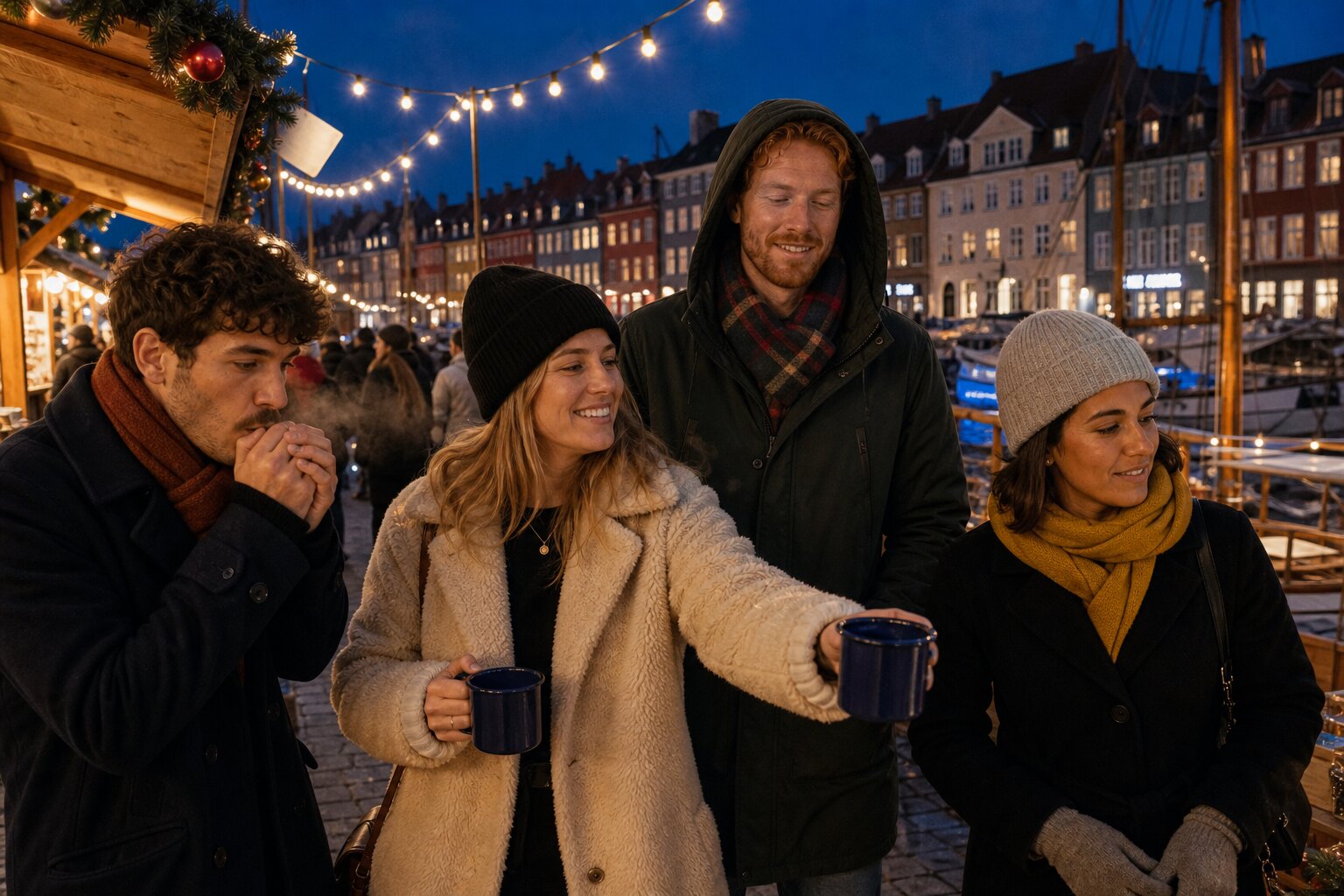
Part of the team of GoRandom in Copenhagen, in December 2022
Part of the team in Copenhagen, December 2022.

Seven things to do, and how to reach each one

Nyhavn included, obligatory photo and all, plus two or three things almost nobody fits into a weekend.

1
Nyhavn and the old harbour
The coloured houses along the canal are the postcard of Denmark and they are packed at all hours. What is worth doing is carrying on north, towards Amalienborg and the Opera, where the city empties out all at once.
M3
Kongens Nytorv — M3 and M4 stop here. You come out of the metro with the canal in front of you.
2
Tivoli, especially at Christmas
An amusement park from 1843 in the middle of the city, with gardens, a theatre and wooden roller coasters. In December it turns into a Christmas market and that is when it really makes sense. It inspired Walt Disney, and it shows.
M3
København H — The main entrance is opposite the central station.
3
Christianshavn and Christiania
A neighbourhood of Dutch canals and, inside it, the free town of Christiania: a former military base occupied since 1971 that is still a social experiment with its own rules. Respect the no-photography signs where they appear.
M1
Christianshavn — The M2 stops here too. Ten minutes on foot to the entrance.
4
Eating at Torvehallerne
Two glass halls with stalls of fish, cheese, smørrebrød and good coffee. It is where you eat well in Copenhagen without paying restaurant prices, and it sits on the city's transport hub.
M3
Nørreport — All four lines stop here, plus the S-trains. It is right outside.
5
CopenHill: skiing on an incinerator
A waste plant with an artificial ski slope on the roof, a climbing wall on the facade and a path to walk up. It is the building that best sums up how this city thinks, and the view from the top is free.
sin metro
It is in Refshaleøen: bus 2A or, much better, the harbour bus boat, which the ticket covers.
6
The harbour baths, in winter too
The harbour water is clean and there are free public pools in it. In December they are used with a sauna alongside, and getting in is a local habit. It is the most Danish thing you can do in an afternoon.
M1
Islands Brygge — The baths are five minutes away, on the canal itself.
7
The Louisiana museum, half an hour by train
Modern art in a house by the sea, with a sculpture park looking across to Sweden. It is rated one of the best museums in Europe and the building is half the argument.
sin metro
Regional train to Humlebæk, about 35 minutes, and 10 on foot.

And the adventure we run here

Everything above you can do on your own with this page open. This other thing we build for you: the same idea as always — you do not know what you got until the day before — applied to Copenhagen.

GO YELLOW
In the harbour water, with no idea what you got
The Go Yellow version of Copenhagen goes into the canal. We give you a meeting point with its metro stop and from there we open the plan: it could be kayaking between the central quays, it could be a floating sauna with a harbour dip, it could be a bike route across Amager to the beach. You find out the day before.
  • The activity, booked and set up
  • Kit and insurance
  • A local instructor
  • A meeting point with a metro stop
Flights and accommodation are not included — you book those. When you pick your departure city we send you a rough estimate of what they cost. We are not a travel agency. How the process works, step by step.

You choose where you fly from and where you are going, and we tell you what the adventure costs and roughly what getting there would cost. Flights and accommodation you book yourself: we are not a travel agency and we do not want to be.

How the transport works, in four numbers

One ticket for metro, bus, S-trains, regional trains and the harbour bus boats. The price depends on how many zones you cross.

Minimum fare
24 DKK
Two zones, which covers almost any journey inside the centre.
Airport to the centre
30 DKK
The airport is in zone 4 and the centre in zone 1, but the ring-zone rule keeps the ticket at three zones.
Hours
24 hours, every day
The metro never closes. At rush hour a train every two minutes and through the night, every fifteen or twenty.
Travelling without a ticket
750 DKK fine
There are inspectors and you pay within fourteen days. A bicycle also needs its own 15 DKK ticket and cannot travel at rush hour.
Source: DOT and Metroselskabet, via our Copenhagen metro guide. Checked on 01 September 2026.

For two or three days the 24- or 72-hour City Pass usually beats single tickets, because it includes the airport. And if you are taking a bike, remember it pays its own fare on the metro.

If you want it line by line — which stations each one has, what is around every stop and how to work out a specific journey — we have all of it at our guide to the Copenhagen metro. It is one of the sites we publish ourselves, and it is free.

From the airport to the centre

Kastrup is eight kilometres out and has both metro and train in the terminal itself. It is one of the best airport links in Europe.

Metro M2
30 DKK
13–15 min
Direct to Kongens Nytorv and Nørreport, dead centre. It runs 24 hours, so it does not matter when you land.
Regional train
30 DKK
13 min
To the central station. Good if you are staying near København H or carrying on to Malmö, half an hour away across the bridge.
With the metro running twenty-four hours for thirty kroner, there is no reason to take a taxi in Copenhagen unless you are travelling with a lot of luggage.
Source: DOT and Metroselskabet. Checked on 01 September 2026.

Four things you will be glad you knew

Hire a bike, even in winter
The city has more bicycles than cars and segregated lanes almost everywhere. People keep cycling in December: you dress for it and that is that.
Denmark does not use the euro
You pay in Danish kroner, though cards work everywhere. Plenty of places do not take cash at all.
Eating out is expensive; smørrebrød less so
A mid-range restaurant adds up fast. Markets, bakeries and smørrebrød counters solve lunch for a good deal less.
In December there are seven hours of daylight
Sunrise around 8:30, dark by 15:30. In exchange the city is lit up and Christmas Tivoli makes up for a lot of the dark.

Frequently asked questions

Two full days cover the centre, Nyhavn, Christianshavn and a museum. With three you can add Louisiana or a trip to Malmö, half an hour away by train across the bridge.

Yes, twenty-four hours every day of the year. It is automatic, with no driver, and through the night it comes every fifteen or twenty minutes.

30 Danish kroner by metro or train, about thirteen minutes. The airport is in zone 4 and the centre in zone 1, but the ring-zone rule makes it a three-zone ticket.

Only if you are going to chain paid museums together. If your plan is more streets, canals, bikes and harbour baths — which is what we recommend — a plain transport City Pass works out better.

Yes, above all for eating and drinking out. Transport is around the European average and many of the best things are free: the harbour baths, CopenHill, the parks and walking around Christianshavn.

And if you fancy being surprised?

This is what we do when we travel. The other thing we do is build adventures where you do not know which activity you got until the day before.

Danos tus datos y te llamaremos.