
Ninety of the Stockholm metro’s hundred stations were decorated by Swedish artists. That is not a piece of trivia: it means the journey is part of the visit, and that changes how you plan a trip here.
The system reads on two levels. On top, three colours: red, green and blue. Underneath, seven numbered sub-lines — T10 and T11 on the blue; T13 and T14 on the red; T17, T18 and T19 on the green — and those are what the platform boards show.
In the centre the colours share track, so from T-Centralen to Slussen any green or red train will do. The sub-line only matters once the colour splits into branches, out in the suburbs.
The city is fourteen islands and that shapes everything: almost no journey is a straight line and walking between neighbourhoods means bridges. The metro skips them.
And then there is the art. The blue line is the spectacular one — Kungsträdgården, Solna centrum, Stadion on the red — because it is cut into bare rock and they left it exposed and painted it. Seeing five or six stations on a 75-minute ticket is one of the best plans in the city.
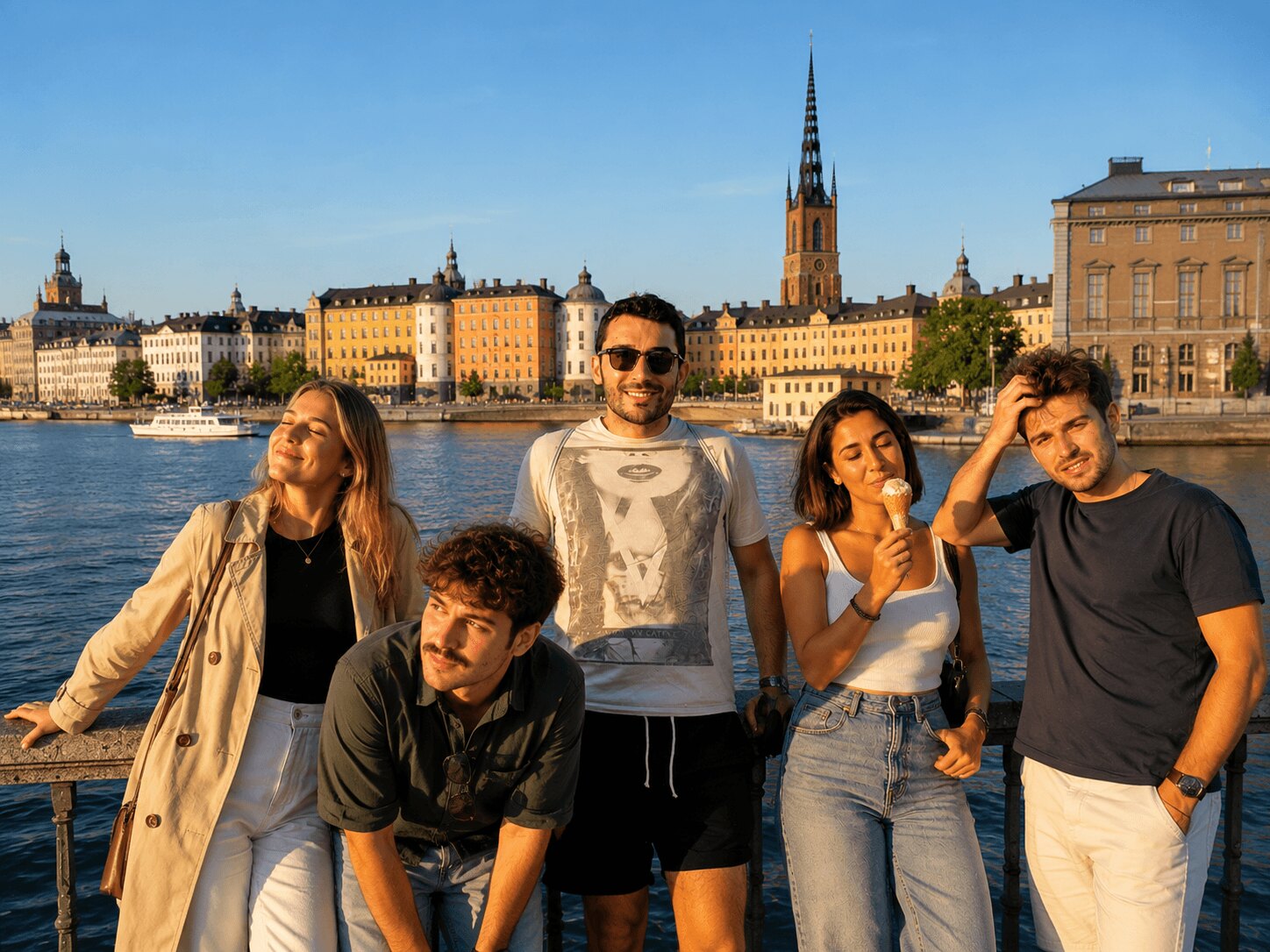
The old town included, because skipping it would be odd, but without staying there, which is the classic Stockholm mistake.
Everything above you can do on your own with this page open. This other thing we build for you: the same idea as always — you do not know what you got until the day before — applied to Stockholm.
You choose where you fly from and where you are going, and we tell you what the adventure costs and roughly what getting there would cost. Flights and accommodation you book yourself: we are not a travel agency and we do not want to be.
SL runs all of it: metro, bus, tram, commuter rail and several boats. Flat fare across the whole region, no zones, since 2017.
With two journeys a day no pass is worth it: pay per trip. From four or five upwards the 24-hour pass wins, and if you do the art-station route you cover it in one afternoon.
If you want it line by line — which stations each one has, what is around every stop and how to work out a specific journey — we have all of it at our guide to the Stockholm metro. It is one of the sites we publish ourselves, and it is free.
Arlanda is forty kilometres out and there are three ways in, at very different prices for the same destination.
Three full days cover Gamla Stan, Djurgården with the Vasa, Södermalm and a run through the art stations. With four the archipelago fits without rushing.
A single ticket is 42 SEK and lasts 75 minutes across the whole SL network, transfers included. The 24-hour pass is 175 SEK, the 7-day 295 SEK and the 30-day 970 SEK.
Yes, and it is one of the few times we say that without qualification. More than ninety of the hundred stations have permanent artwork and the blue line, cut into the rock, is like nothing else. A 75-minute ticket covers five or six.
It is expensive, above all for eating out and alcohol — which is only sold in the state Systembolaget shops. Transport and museums are around the European average, and a good deal is free: the viewpoints, the nearby archipelago and the stations themselves.
June and July, for the light and the terraces, with the city half empty of Swedes in July. December has markets and snow but very little daylight. The months in between are grey and the least rewarding.
This is what we do when we travel. The other thing we do is build adventures where you do not know which activity you got until the day before.