
ESEN

What to do in Milan and how to get around

Milan has the most useful metro in Italy and a reputation as the country’s least interesting city. The first is true. The second comes from people who spent four hours between the Duomo and the station.

We were in Milan in September 2025Updated in 2026

Here the metro really does reach everything

Five lines — M1 red, M2 green, M3 yellow, M4 blue and M5 lilac — and a compact city. After Rome the feeling is relief: almost everything you will want to see has a stop less than ten minutes’ walk away.

The centre is organised in rings around the Duomo. Inside the first is almost all of the postcard; the second is where the city gets genuinely interesting — Navigli, Isola, Porta Venezia — and there the metro is what decides whether you see two neighbourhoods or five.

The only trap is financial: in Milan you have to tap out as well if you pay contactless. If you do not, the system charges you the maximum fare.
Part of the team of GoRandom in Milan, in September 2025
Part of the team in Milan, September 2025.

Seven things to do, and how to reach each one

The Duomo included, because skipping it would be odd, but not first.

1
Going up onto the Duomo terraces, not just inside
The cathedral interior is fine; the real plan is the roof. You walk among the spires, level with the gargoyles, with the city underneath. There is a lift and there are stairs, and the stairs are cheaper and have a shorter queue.
M1
Duomo — M1 and M3 both stop here. You come out of the concourse and it is in front of you.
2
The Last Supper, if you booked weeks ago
Thirty-five people enter every fifteen minutes and tickets go months ahead. If you do not have one, do not waste the morning: the cloister of Santa Maria delle Grazie is open anyway and it is empty.
M1
Conciliazione — Cadorna, on M1 and M2, leaves you the same distance away on the other side.
3
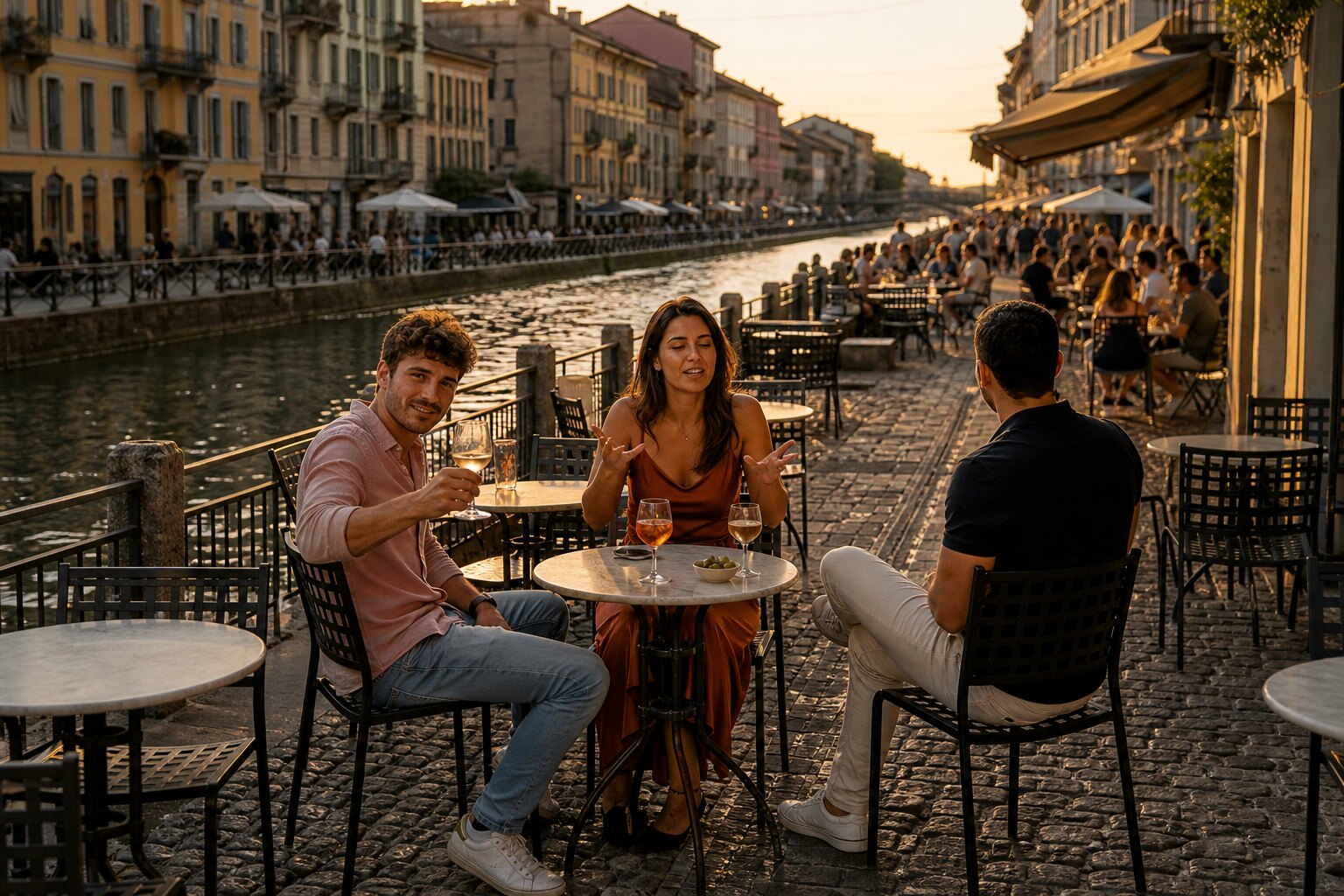
The Navigli at aperitivo time
The canals Leonardo helped design, now lined with terraces. The Milanese aperitivo — you pay for the drink and the food comes with it — is the best value in the city, and this is where it is done best.
M2
Porta Genova — Five minutes on foot to the Naviglio Grande.
4
Wandering Brera by day
The pretty neighbourhood of Milan: narrow streets, galleries, and the Pinacoteca, one of the most underrated museums in Italy. It works much better on a weekday morning.
M2
Lanza — Montenapoleone (M3) comes out on the expensive-shops side.
5
The Cimitero Monumentale, odd as it sounds
It is an open-air sculpture museum, free, and there is almost never anyone there. Art nouveau mausoleums, enormous marble and silence twenty minutes from the Duomo. One of the places that surprised us most.
M5
Monumentale — The M5 has a stop named after the cemetery. Hard to miss.
6
Fondazione Prada, even if art is not your thing
The building alone justifies the visit: a converted distillery by Rem Koolhaas with a gold-leafed tower in the middle. The bar was designed by Wes Anderson and looks exactly like you are imagining.
M3
Lodi T.I.B.B. — Ten minutes on foot from the exit.
7
San Siro, with or without a match
One of the most storied stadiums in Europe and one whose days are numbered: there are plans to replace it. With no match on, the tour goes into the dressing room and the tunnel.
M5
San Siro Stadio — The M5 goes to the door. It used to mean taking a bus.

And the adventure we run here

Everything above you can do on your own with this page open. This other thing we build for you: the same idea as always — you do not know what you got until the day before — applied to Milan.

GO YELLOW
A day on the canals, with no idea where you end up
The Go Yellow version of Milan leaves the centre: we give you a starting point in the Navigli area and you find out the rest when you get there. It could be kayaking the canal, it could be a bike route along Leonardo's locks. Calm, but not the usual guided tour.
  • The activity, booked and set up
  • Kit and insurance
  • A local instructor
  • A meeting point with a metro stop
Flights and accommodation are not included — you book those. When you pick your departure city we send you a rough estimate of what they cost. We are not a travel agency. How the process works, step by step.

You choose where you fly from and where you are going, and we tell you what the adventure costs and roughly what getting there would cost. Flights and accommodation you book yourself: we are not a travel agency and we do not want to be.

How the transport works, in four numbers

The whole city sits in the same fare zone (Mi1–Mi3), so the urban ticket covers any journey inside Milan.

Urban ticket
€2.20
Valid 90 minutes with surface transfers, but only one entry to the metro.
Day / 3 days
€7.60 / €15.50
There is also a 10-journey carnet at €19.50 and a weekly pass at €18.50.
Paying by card (CleSS)
€2.20 per journey
Automatic daily cap of €7.60. Careful: you have to tap the card on the way in AND on the way out, or you are charged the maximum fare.
Hours
05:30 – 00:30
Wider than Rome, and enough to have dinner without watching the clock.
Source: ATM Milano. Checked on 01 September 2026.

With the €7.60 daily cap on card, the three-day pass (€15.50) only pays off if you make more than two journeys a day on all three days. We ended up paying per journey.

If you want it line by line — which stations each one has, what is around every stop and how to work out a specific journey — we have all of it at our guide to the Milan metro. It is one of the sites we publish ourselves, and it is free.

From the airport to the centre

Milan has three airports and the usual one for international flights is Malpensa, which is genuinely far out: 50 km.

Malpensa Express
€15
37–50 min
Four trains an hour. To Cadorna is about 37 minutes; to Centrale, about 50. A same-day return costs €25.
Airport coaches
from ~€10
50–60 min
Several companies run to Centrale. Cheaper and slower, and with Milan traffic the hour can stretch.
If your hotel is around Brera, Cadorna or the Navigli, get off at Cadorna: it is more central than Centrale and the train takes less time.
Source: Trenord · Malpensa Express. Checked on 01 September 2026.

Four things you will be glad you knew

Tap out or you overpay
It is the most expensive and most common mistake. With a contactless card you have to touch the gate going in and coming out.
The aperitivo is dinner
Between 18:30 and 21:00 many bars include a buffet with the drink for €10–15. Use it and you save a meal a day.
August is shut
Milan is a working city and it empties in August. Many restaurants and shops close for weeks at a time.
Two days is plenty
And the third is better spent on Lake Como, 40 minutes by train from Cadorna or Centrale.

Frequently asked questions

It is worth two days. The boring reputation comes from most people only seeing the Duomo and the Galleria, which is the least interesting part. Navigli, Brera, the Cimitero Monumentale and Fondazione Prada change the impression a good deal.

€2.20 for the urban ticket, valid 90 minutes. Paying contactless is the same price per journey and never goes above €7.60 a day. You have to tap out as well.

Practically not. Thirty-five people per slot and tickets sell out months ahead. The odd last-minute space is released on the official site, but counting on it is risky.

Regional train from Cadorna (to Como Nord Lago, which leaves you on the promenade) or from Centrale (to Como San Giovanni). About 40–60 minutes depending on the train. It is the easiest day trip from the city.

And if you fancy being surprised?

This is what we do when we travel. The other thing we do is build adventures where you do not know which activity you got until the day before.

Danos tus datos y te llamaremos.