
ESEN

What to do in Tashkent and how to get around by metro

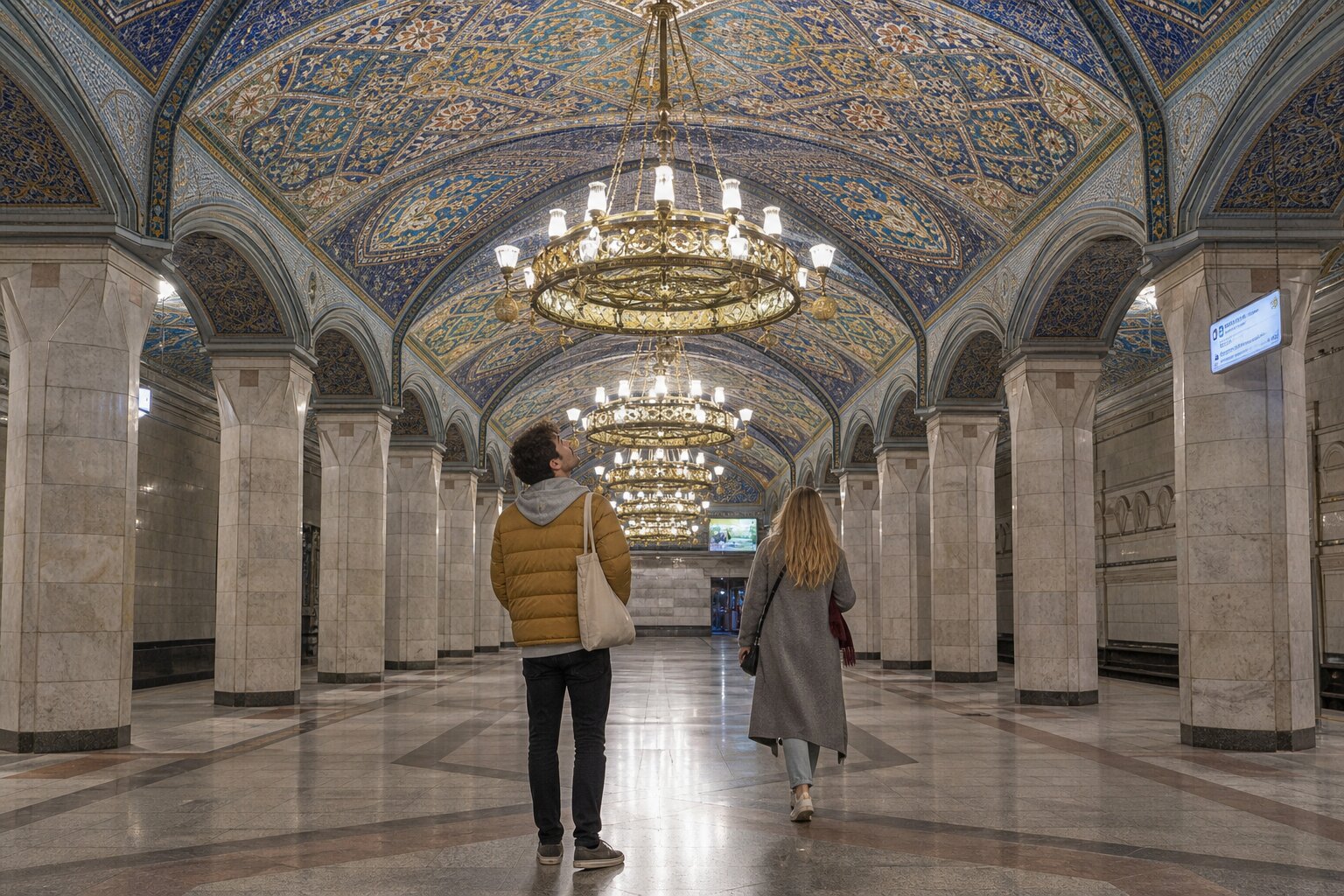
For decades it was illegal to photograph the Tashkent metro: it doubled as an air-raid shelter. Since 2018 you can, and it turns out it had spent forty years hiding the most ornate set of stations outside Moscow.

We were in Tashkent in November 2025Updated in 2026

Four lines and a rebuilt city

The metro opened in 1977 and was the first in Central Asia. It was built after the 1966 earthquake, which destroyed much of the city, and that explains the Tashkent you see today: enormously wide avenues, Soviet blocks and very little old town.

There are four lines: Chilonzor (1, red), Oʻzbekiston (2, blue), Yunusobod (3, green) and the Circle (4, elevated, opened in 2020, ringing the outer districts). Fifty stations and about seventy kilometres.

The first three cross in the centre and are the ones you will use. The circle line runs outside and only makes sense for reaching specific neighbourhoods.

The point that matters for a trip: distances in Tashkent are enormous, far more than the map suggests. What would be a ten-minute walk in another city is thirty here, with eight-lane avenues in between. The metro is not a convenience, it is the only reasonable way to move.
Part of the team of GoRandom in Tashkent, in November 2025
Part of the team in Tashkent, November 2025.

Seven things to do, and how to reach each one

Tashkent is not Samarkand or Bukhara, and anyone arriving expecting that is disappointed. It is another thing, and these seven are the ones that convince us.

1
Going down to the metro just to look
Kosmonavtlar, with cosmonaut portraits on blue ceramic; Alisher Navoiy, with blue brick domes like a madrasa; Mustaqillik Maydoni, marble and a crystal chandelier. Photography has been allowed since 2018 and it has been the city's first sight ever since.
L2
Kosmonavtlar — One ticket covers several: you do not have to exit to change line.
2
The Chorsu bazaar
Under a giant turquoise dome, the market as it always was: mountains of spices, dried cheese, melons, and the best place in the city for cheap plov on the upper floor. It is the piece of Tashkent that survived the earthquake and the rebuild.
L2
Chorsu — The station is inside the bazaar complex itself.
3
The Hazrati Imam complex
Madrasas, minarets and the Barak-Khan mosque around a square, and inside it the Uthman Quran, one of the oldest surviving copies. It is the spiritual part of the city and the one that most resembles what people imagine of Uzbekistan.
L2
Chorsu — About twenty minutes on foot from Chorsu. There is no closer station: count on the walk or take a short taxi.
4
Amir Temur square and the Timur museum
The symbolic centre of present-day Tashkent: the equestrian statue of Tamerlane, the turquoise-domed museum and the avenues fanning out. It is worth it for what it explains about the country more than for what you see.
L1
Amir Temur Xiyoboni — The station comes out onto the square itself.
5
The TV tower at sunset
375 metres, an observation deck at 100 and a revolving restaurant that is pure 1980s. The view makes sense of the scale of the city and, with the sun low, reaches the Tian Shan mountains.
L3
Bodomzor — Ten minutes on foot. You need your passport to get in.
6
Independence Square and the memorial
An enormous esplanade with arches, fountains and the memorial to the Second World War dead, with an eternal flame and bronze books of names. Twenty minutes to cross and the best picture of recycled Soviet urbanism.
L1
Mustaqillik Maydoni — The station is named after the square and opens onto it.
7
The Chimgan mountains, a day away
An hour and a half east the Tian Shan begins: chairlifts, trails and snow in winter. It is what people from Tashkent do at weekends and the best contrast with the city.
sin metro
By shared taxi or organised trip from the city. Full day.

And the adventure we run here

Everything above you can do on your own with this page open. This other thing we build for you: the same idea as always — you do not know what you got until the day before — applied to Tashkent.

GO YELLOW
A day in the Tian Shan, with no idea what you got
The Go Yellow version of Tashkent leaves the city for the mountains. We give you a meeting point with its metro stop and from there we open the plan: it could be a walking route through the Chimgan valleys, it could be horses on the high steppe, it could be snow if the season allows. You find out the day before.
  • The activity, booked and set up
  • Transfer from the city
  • Kit and insurance
  • A meeting point with a metro stop
Flights and accommodation are not included — you book those. When you pick your departure city we send you a rough estimate of what they cost. We are not a travel agency. How the process works, step by step.

You choose where you fly from and where you are going, and we tell you what the adventure costs and roughly what getting there would cost. Flights and accommodation you book yourself: we are not a travel agency and we do not want to be.

How the transport works, in four numbers

Flat fare: two stations cost the same as crossing the whole network, transfers included as long as you do not exit. What does change is how you pay.

Paying by card or phone
1,700 som
ATTO card, contactless bank card, phone or QR from the app. The normal way to pay since tokens were withdrawn in 2020.
Paying cash
3,000 som
A paper QR ticket from the station machines. It costs almost double on purpose, to push people towards electronic payment.
Hours
05:00 – 24:00
Every day, with first trains around five and the last around midnight.
Frequency
2–4 min at peak
On weekdays. About 5 minutes off-peak and 7 to 10 in the evening and at weekends.
Source: Toshkent Metropoliteni, via our Tashkent metro guide. Checked on 01 September 2026.

Bring a contactless card that works abroad and stop worrying about the rest: paying cash costs almost twice as much and means queuing at the machine.

If you want it line by line — which stations each one has, what is around every stop and how to work out a specific journey — we have all of it at our guide to the Tashkent metro. It is one of the sites we publish ourselves, and it is free.

From the airport to the centre

Tashkent international airport is about six kilometres from the centre, very close by usual standards, but with no metro.

Taxi or ride-hailing
variable
20–30 min
The normal choice. Book through an app — Yandex Go works here — rather than negotiating at the arrivals door, where the price multiplies.
City bus
city fare
35–45 min
There are routes into the centre. Very cheap, but with luggage and without reading Cyrillic or Uzbek it is not the best first experience.
The nearest metro station is not at the terminal, so the airport leg is a taxi job. After that, everything else is metro.
Source: Toshkent Metropoliteni. Checked on 01 September 2026.

Four things you will be glad you knew

You can take photographs in the metro now
It was banned until 2018 because the stations doubled as air-raid shelters. Today it is legal and normal, though some stations still have police: if you are told something, do not argue, move on.
The som comes in large numbers
Prices have a lot of zeros and until recently you carried wads. Today cards work for almost everything urban; for bazaars and taxis, cash.
Spring and autumn are the best seasons
April–May and September–October. In July and August it passes 40 °C easily and in January it drops below zero. The metro, by contrast, is climate-controlled all year.
Tashkent is the base, not the destination
Most people use it as the gateway to Samarkand and Bukhara, two and four hours away by high-speed train. Book that train ahead: it fills up.

Frequently asked questions

Two full days is more than enough for the city: the stations, Chorsu, Hazrati Imam and the squares. Tashkent works better as a base for Samarkand and Bukhara than as a long destination in itself.

1,700 som paying with an ATTO card, a bank card, a phone or a QR code, and 3,000 som if you buy a paper ticket with cash. The fare is flat: it does not depend on distance or transfers.

Yes, since 2018. It was banned before because the metro also served as an air-raid shelter. Today it is one of the main tourist attractions in the city.

Citizens of the European Union can enter without a visa for short tourist stays. Confirm the current conditions before travelling, because the country has been widening them in recent years.

Yes, and it is the best way: the Afrosiyob high-speed train takes about two hours. Buy online or at the station, and in high season it sells out days ahead.

And if you fancy being surprised?

This is what we do when we travel. The other thing we do is build adventures where you do not know which activity you got until the day before.

Danos tus datos y te llamaremos.