Snorkelling
One of the 17 activities you could get with Go Orange, from €35 per person. Like all of them, you do not find out this is the one until between 48 and 24 hours beforehand.
About snorkelling
What is snorkelling?
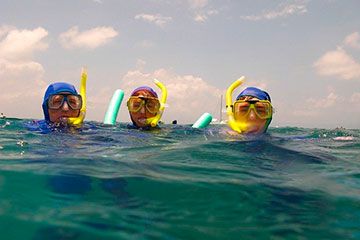
Snorkelling is diving at the surface. It is the easiest way to see what is under it. You need no previous experience and no great pile of kit, and you can do it alone or with friends.
No previous experience is needed, but the weather at the start time is taken into account to keep everyone safe and make sure the session runs properly
Activity at a glance
Snorkelling kit
- A qualified specialist instructor.
- Public liability and accident insurance.
- An approved wetsuit.
- An air cylinder.
- Approved fins and mask.
To start with you need the snorkel itself, usually about 30 cm long and 2 cm across. It is normally silicone and shaped like a J. At the lower end there is a mouthpiece. Next you needa mask, which is what lets you see below the surface comfortably. On top of that people sometimes use fins. They are not essential, but they do make moving through the water a great deal easier.
Finally you can wear a snorkelling vest, which keeps you afloat so that you stay comfortable and do not tire yourself out. You inflate it by blowing into it.
Duration
This activity lasts about 2 hours.
How much snorkelling costs
This activity costs €32 per person and includes the experience, the kit and video of the session.
Where to go snorkelling in the Basque Country
We would suggest snorkelling in Bizkaia
You can also make the most of the coast and go snorkelling in Gipuzkoa
And you can go snorkelling in Álava
When is the best time to snorkel?
This kind of activity runs from March to October, because it depends on the weather to be run properly.
When spring and summer arrive with better weather, most of us want to do the things we shelved over the winter, water among them. Snorkelling is one that a lot of people know about and rather fewer actually do, unlike surfing.
Unlike water sports where the point is adrenaline or technique, this one is calm: the point is what is around you. You get to see the seabed without diving and without specialist equipment, which makes it open to anyone who can swim and is comfortable in water.
Calm as it is, it happens at sea, so precautions still apply and you should know at all times what is around you.
It is one of the safest water sports there is: it usually happens over shallow water, at the surface, somewhere sheltered with very little swell.
All you really need is to be able to handle yourself in water. It also helps a great deal to be familiar with the kit: the mask, which lets you see the seabed, and the snorkel, which lets you breathe with your face in the water.
What makes for a good session
Here are a few things worth bearing in mind.
Safety is the thing people think least about. As we said, it is a calm and reasonably safe activity, which is no reason to skip the precautions. The first of them: do not go on your own.
It is always advisable, and arguably necessary, to snorkel in pairs or in a group, so that somebody is always with you. If anything goes wrong you can help each other or call for help, and having someone keeping an eye out prevents most accidents in the first place.
Beyond safety, doing it with friends or family is simply better, because you can talk about what you saw afterwards. And shared experiences are always worth more than solitary ones.
The other thing to remember is that this is not our element, so the job is to look and enjoy the view . Touch nothing and disturb nothing. Plenty of things down there look harmless and are not.
A good many corals cause allergic reactions, and reaching out to one can turn a good morning into a bad one. Remember: look, do not touch. For your own sake.
With the basics covered you can plan the session: the kit above, and where you are going to do it.
It usually happens off a beach, where there is often an area marked out with buoys. Stay inside it: outside it you may drift too far from a shore you should always be able to place, or into water where something else is going on.
Knowing where you are also means you can stop whenever you want to, if you suddenly find yourself tired.
If you are out in open water off a boat, the same applies: keep track of where you are so that going back is straightforward. In that case the boat is your shore.
Finally, look at the state of the sea. What you want is calm water , because swell makes it awkward: harder to swim calmly and harder to breathe. On a bad day the current can take you out and away from the shore, which is a risk nobody needed to run.
Swell also stirs up the bottom and ruins the visibility. There is no point snorkelling in rough water, because you will not see the thing you came for.
There is more about snorkelling, and the latest news, on the blog of the Spanish Underwater Activities Federation (FEDAS). You will also find membership prices, licences, insurance and related matters.
Read about other activities like it behind the button below.
Related activities in the Basque Country