Kitesurfing
One of the 13 activities you could get with Go Red, from €75 per person. Like all of them, you do not find out this is the one until between 48 and 24 hours beforehand.
About kitesurfing
What is kitesurfing?
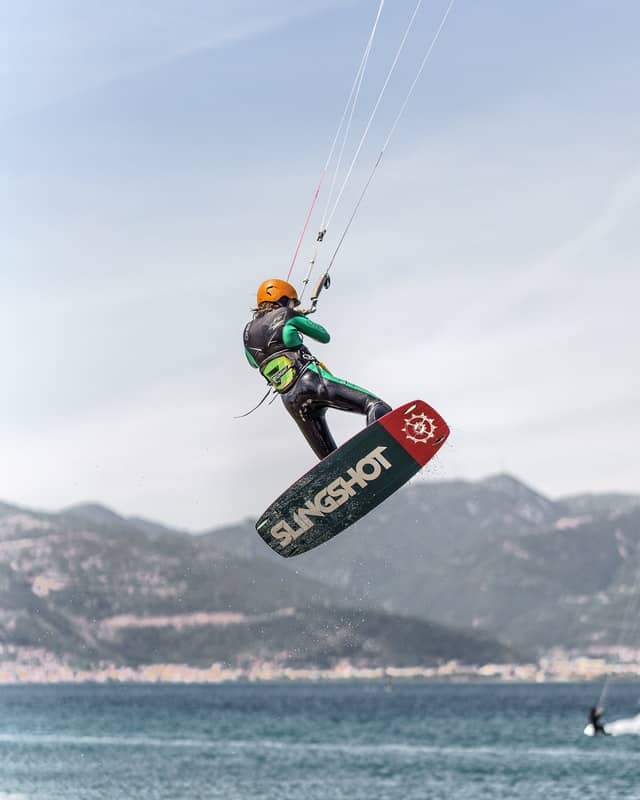
Kitesurfing, also called flysurfing or kiteboarding, is a sport in which you slide across the water pulled by a kite, attached to you by a harness, which the wind drives.
With that and a board you can ride across the water — and the braver among us do things in the air as well.
Activity at a glance
Kitesurfing courses
If you want to take a kitesurfing course, write to us and we will tell you what the options are.
We will also go through what the sport asks of you.
Physically, you do not need to be in any particular shape or especially young: children of 6 or 7 do it, provided they weigh at least 35 kg, and so do people in their sixties.
That said, it counts as a risk sport and it does ask for coordination, stamina and strength, both to do it properly and to avoid hurting yourself.
Kitesurfing kit
First you need a kite to turn the wind into movement. There are many types, chosen according to the wind where you are riding and to size. Light wind means a big kite; strong wind means a small one.
Your own weight matters too: a small kite behaves very differently for someone of 55 kg than for someone of 80 to 90. And there are kites designed for particular disciplines, freestyle among them.
Beginners are best off in light wind with a big kite, which feels a good deal safer.
Then the bar, which is how you control the kite. Buy it at the same time as the kite, or from the same brand, to avoid compatibility problems — and pick the one that feels right in your hands.
At GoRandom we would encourage you to look into it. It is unlike the other water sports, it goes down very well with people who try it, and it is learned faster and more easily than surfing. If you do not fancy going it alone, a school will teach you what you need.
Next, the harness, which can be a seat or a waist harness. Beginners usually start with a seat harness, which is more stable and moves less, and so makes the first sessions easier. Waist harnesses come later, once you have the sport more under control; they are more comfortable between the legs and easier to tighten.
Finally you need a board to ride on. Again, the choice depends on your size and on the wind. A big board planes more easily than a small one because there is more of it, and it means moving the kite less, which matters a great deal when you are learning. And as with the kite: big board for light wind, small board for strong wind.
One more thing, common to most water sports: the wetsuit. Nothing kitesurfing-specific is required, though there are models made for it that are more comfortable because they stretch more. Its job is to keep the cold out, so pick a thickness according to how cold you get in the water.
How much kitesurfing costs
This activity costs €32 per person and includes the experience, the kit and video of the session.
Where to go kitesurfing
With GoRandom you can kitesurf across the Basque Country
- You can also kitesurf in Gipuzkoa
The sport needs wind, obviously, and it needs it reasonably steady: between 15 and 30 knots unless you are a very experienced rider, blowing towards the shore of wherever you are, beach or lake.
Fresh water or salt makes no difference; what matters is the conditions.
One thing to watch: stay well away from swimmers and from boats.
The sport is biggest in the south of Spain — the coast of Cádiz is one of its capitals — and in the Canaries, particularly Tenerife and Fuerteventura.
Kitesurfing season
This kind of activity runs from March to October, because it depends on the weather to be run properly.
Where kitesurfing came from
It goes back to the 12th century, when Chinese fishing communities are recorded using small kites to drive the boats they fished from.
In the late 1970s the inventor Gijsbertus Adrianus Panhuise took out the first sporting patent, for a kite traction system for boats and carts, which made him the first kitesurfer.
What kitesurfing does for you
Like most sports it is good for you: it works the upper body, the lower body and the core, which makes it about as complete as exercise gets. There are a few other things worth mentioning.
It uses a great many muscles, which builds strength and stamina, and it develops balance and coordination along the way.
People who do it also say it is very effective at bringing stress down while letting you burn off adrenaline, on top of the sea and the views. And it puts you among people who like the same things.
Spanish Kitesurfing Federation
Every session is supervised by one or more qualified specialist instructors so that you can just enjoy it.
The sport is classed as a sailing activity by the Royal Spanish Sailing Federation (RFEV), which runs workshops, conferences, talks and exhibitions on safety and preparation, and publishes competition calendars and national and international rankings.
If you liked what you read here you can read about other sports and other options on the link below:
Related activities in the Basque Country